In the previous two articles of this series, we traced how the medieval Eastern Christian world fragmented after the failed Union of Florence and the fall of Constantinople (Part 1), and how the eastern Rusyns of the Polish-Lithuanian Commonwealth produced the Union of Brest in 1596 — and through it, eventually, what we now call Ukrainian identity (Part 2).
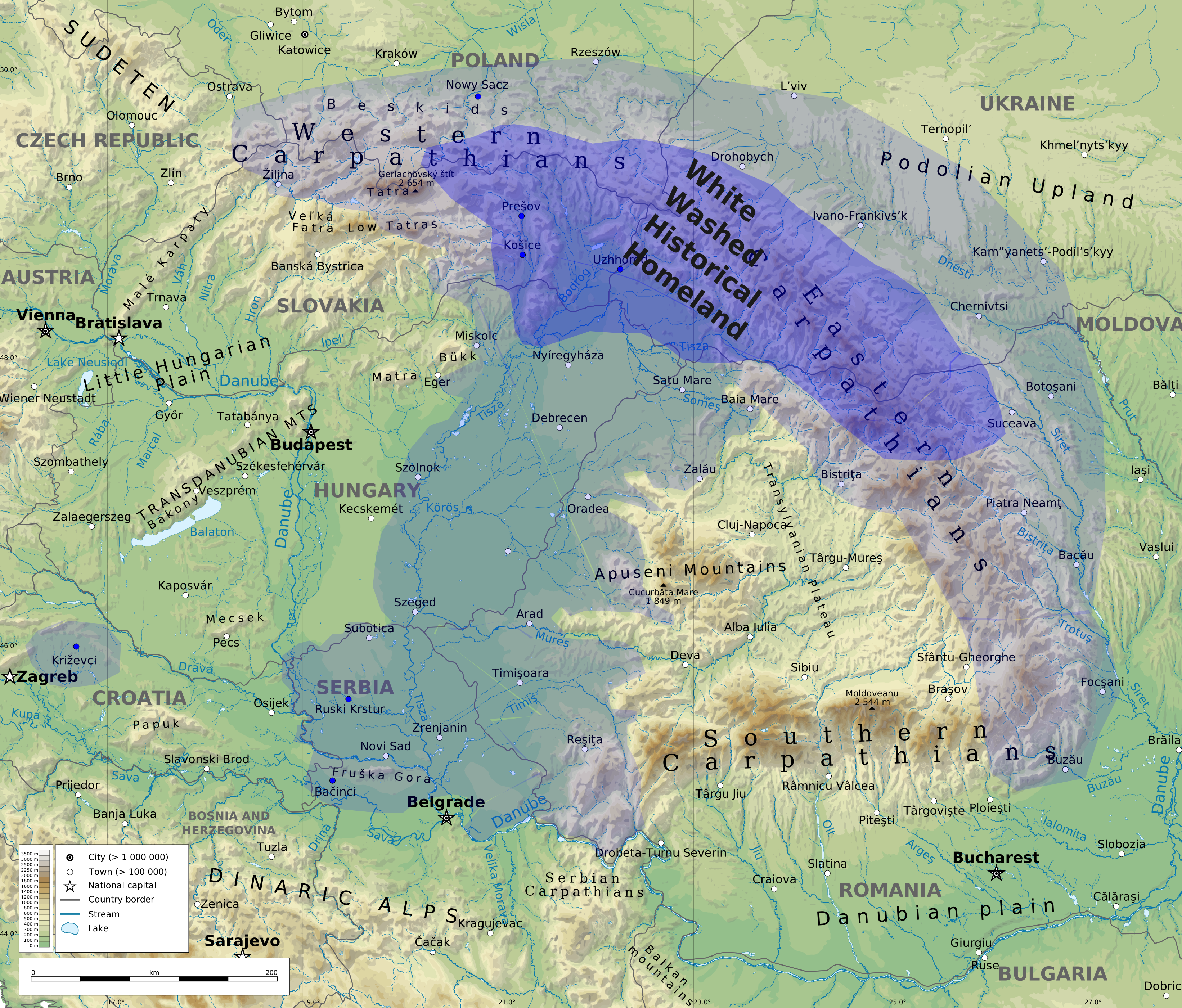
This article is about the fourth Rusyn-speaking population from that split: the Carpatho-Rusyns who lived in and immediately west of the Carpathian Mountains, mostly under the Kingdom of Hungary. They had been having a completely different historical experience from their cousins to the east. They were not in the Commonwealth. They had no Cossacks. They were largely untouched by the Mongol invasions. The Deluge would not reach them. And when their own union with Rome eventually came, at Uzhorod in 1646, it was the product of that different experience — a union made under different conditions, by a different people, on its way to a different future.
The Union of Uzhorod created what would eventually become the Byzantine Catholic Church.
Spared by the Mountains
While the eastern Rusyns were being squeezed by Polonization from the west and Moscow from the east, and while the Cossack uprisings of the seventeenth century were about to engulf the eastern Commonwealth, the Rusyn-speaking peoples west of and within the Carpathian Mountains were having a fundamentally different historical experience.
The Carpatho-Rusyns had been jurisdictionally separated from the Rus east of the mountains since their earliest Christianization. They had received the faith as early as 860 AD through the missions of Cyril and Methodius, more than a century before the formal baptism of Kievan Rus in 988. They had been part of the Kingdom of Hungary for centuries, sharing political space with Hungarians, Slovaks, Poles, and Romanians rather than with their cousins to the east. They were not part of the Polish-Lithuanian Commonwealth, so the Russo-Polish wars passed them by. They had no Cossacks. They experienced neither the Deluge nor the Ruin in any direct sense.
What they had instead were centuries of cultural exchange with their Catholic Western neighbors and a strong sense of their own Eastern liturgical tradition. By the early 1600s, the conditions for a different kind of union were in place: a population with deep Eastern Christian roots, surrounded by Catholic powers, sharing a kingdom with Catholic Hungarians, and largely untouched by the anti-union political pressure that the Ottoman-occupied Greek world and the Cossack uprisings had created elsewhere.
But they were not untouched by all political pressure. The pressure they faced was a different kind altogether — and it came not from the East, not from Orthodoxy, but from a source most readers today would never expect.
The Long Road to Uzhorod
The Union of Uzhorod did not happen on the first attempt. It was the third or fourth, depending on how you count — and the previous attempts had failed in ways that say a great deal about what the Carpatho-Rusyns were up against.
The first serious attempt came in 1614, when roughly fifty Carpatho-Rusyn priests gathered at the Krasny Brod Monastery with the explicit intention of entering union with Rome. They never got the chance. An Orthodox mob — a mix of laity and anti-union clergy — descended on the monastery, broke up the gathering, and dispersed the priests before any formal act of union could be signed. Later that same year, Bishop Vasyl Tarasovych of Mukachevo traveled to declare a union, but it never formally materialized. A second attempt in the 1630s also failed. Tarasovych himself eventually accepted union personally in May 1642 at Laxenburg, Austria, in the presence of Emperor Ferdinand III — but bringing his clergy and people along with him was another matter.
Behind these failures lay a complicated political reality. The Kingdom of Hungary in this period was split into three parts: Habsburg Royal Hungary in the northwest, Ottoman-occupied central Hungary in the middle, and the Principality of Transylvania — nominally an Ottoman vassal but functionally independent — in the east. Transylvania was ruled by the powerful Rákóczi family, who were committed Calvinists. Much of the Carpatho-Rusyn population, particularly the eastern parts of the Eparchy of Mukachevo, lived under Transylvanian rule, where their Orthodox bishops and parishes fell under direct Calvinist political pressure.
This is one of the more surprising twists in this story: the most determined enemies of the Union of Uzhorod were not Orthodox; they were Protestant.
The reason was straightforward political calculation. The Rákóczi princes saw any Carpatho-Rusyn alignment with Catholic Habsburg Austria as a strategic threat. Many Ruthenian peasants and serfs lived on Calvinist estates, and their Calvinist landlords were already trying to pressure them toward Protestantism. A union with Rome — politically aligned with the Habsburgs — would put these populations firmly out of Calvinist reach. The Rákóczis worked actively to prevent it.
In May 1643, Prince György Rákóczi I declared the see of the western-leaning Bishop Tarasovych — who just a year earlier had declared the union with the Catholic Church — vacant, and installed his own puppet-bishop, János Juszkó. The main Carpatho-Rusyn Eparchy was effectively split in two by the Protestant scheming. This was a direct political attempt to keep the Carpatho-Rusyn church divided and away from Rome.
The Union of Uzhorod, 1646
It was against this backdrop that the actual Union finally took place.
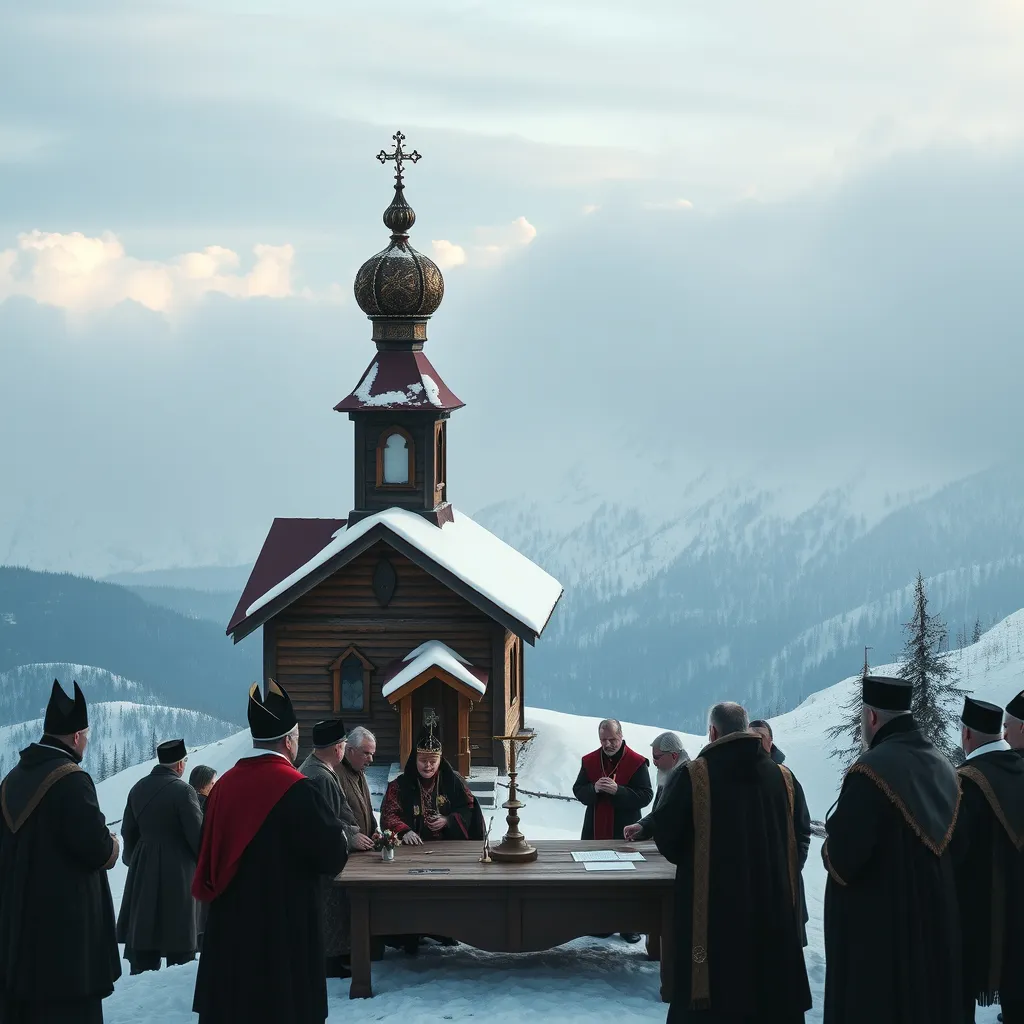
On April 24, 1646 — the feast day of St. George the Martyr — sixty-three Carpatho-Rusyn priests gathered in the castle church of Uzhorod, on the estate of Count György Drugeth, a Catholic Hungarian magnate sympathetic to the cause. Bishop György Jakusics of Eger, the Latin Catholic bishop of the region, presided over the act. The Basilian monk Petro Parfenii (Peter Parthenius), who would become the first united bishop, led the assembled clergy. After the Divine Liturgy was celebrated in the Ruthenian tongue and confessions were heard, the sixty-three priests pronounced the profession of Catholic faith aloud and signed the union document.
The terms followed the general pattern established by Florence and reaffirmed at Brest:
- Retention of the Byzantine Rite and all Eastern liturgical practices.
- Recognition of the Pope as the spiritual head of the Church.
- Preservation of married clergy and the existing Eastern hierarchy.
- Continued use of Church Slavonic and local Ruthenian customs.
It is worth being honest about the scope of this initial act. Those 63 priests represented only about ten percent of the clergy in the Eparchy of Mukachevo. They were drawn almost entirely from the estates of the Drugeth family — most of present-day eastern Slovakia (the Prešov region) and a portion of Subcarpathian Rus’ — which lay within Habsburg Royal Hungary and therefore outside the reach of Calvinist Transylvania. The eastern parts of the eparchy, in Rákóczi territory, were simply unreachable.
The Calvinist response was immediate and lasting. In 1652, the Rákóczi family seized the Mukachevo Monastery itself — the symbolic center of the eparchy — forcing Bishop Parthenius to relocate the eparchial seat to the Krasny Brod Monastery, where it would remain until 1742. That same year, Zsuzsanna Lorántffy, the formidable Calvinist widow of György Rákóczi I, facilitated the election of yet another anti-bishop, János Zejkán, through a Calvinist-influenced process, ensuring that a non-united Byzantine-rite hierarchy would continue to compete with the united one.
In short, the Union of Uzhorod was contested almost from the day it was signed — not primarily by Orthodox resistance from within the community (though some of that existed too) but by external Calvinist political power determined to keep the Carpatho-Rusyns out of Catholic hands.
From 63 Priests to a Church
The consolidation of the union into the modern Ruthenian Rite Byzantine Catholic Church took more than a century and required several major political shifts. Three turning points were decisive.
The Treaty of Karlowitz (1699) ended the Great Turkish War and reunited the entire Kingdom of Hungary — including Transylvania — under Habsburg rule. With the Calvinist Principality of Transylvania absorbed into Catholic Habsburg administration, the political pressure that had kept large parts of the Eparchy of Mukachevo out of the union dissolved. Over the next several decades, parishes that had previously been beyond reach began joining the union in waves.
Karlowitz also opened up something the Carpatho-Rusyn world had never seen before: empty land to the south. The central and southern parts of Hungary — depopulated by a century and a half of Ottoman warfare — lay nearly vacant when the Habsburgs reclaimed them. The imperial administration actively encouraged repopulation, and Rusyns from the overcrowded Carpathian uplands were among the migrants who moved south to fill the empty plains. The migration unfolded over decades, beginning soon after Karlowitz and progressing steadily southward. By the 1740s, the leading edge of Rusyn settlement had reached as far as modern Vojvodina, Serbia — where Ruski Krstur would found a Greek Catholic Rusyn parish in 1751 and a Rusyn-language school in 1753 that has run continuously ever since. The Mukachevo eparchy’s pastoral reach now extended hundreds of miles south of the Carpathians, into territory it had never imagined serving.
The canonical establishment of the Eparchy of Mukachevo (1771). For most of the union’s first century, the united Carpatho-Rusyn bishops technically remained subordinate to the Latin Catholic bishops of Eger — a situation that was canonically irregular. In 1771, Pope Clement XIV issued the apostolic constitution Eximia Regalium Principum, formally establishing the Greek-Catholic Eparchy of Mukachevo as an independent eparchy directly subject to Rome. The seat of the eparchy was later transferred to Uzhorod itself. This act did not happen in a vacuum — it was actively pushed by the Habsburg court of Maria Theresa, which had its own reasons to want Eastern Catholic structures properly formalized within the empire. Those reasons would become clear the very next year.
The First Partition of Poland (1772). This is the third and arguably most consequential turning point, and it dramatically reshaped the entire Eastern Catholic world. When the Polish-Lithuanian Commonwealth was partitioned between Russia, Prussia, and the Habsburg Empire, the Habsburgs received the southern portion — most of historic Red Ruthenia, including Lviv. Maria Theresa organized this territory as the new Habsburg crownland of the Kingdom of Galicia and Lodomeria. Overnight, the Habsburg Empire became home to two large Greek Catholic populations: the Carpatho-Rusyns of the Eparchy of Mukachevo (already there for a century) and the much larger body of Galician Ruthenians from the Union of Brest (newly inherited from Poland). For the first time in memorable history, the Rusyn-speaking populations on both sides of the Carpathians were united under a single political authority — a development that would accelerate the modern questions about national identity that Carpatho-Rusyns are still navigating today.
The Habsburg response was to actively support and elevate Greek Catholicism throughout the empire. In 1774 Maria Theresa officially decreed that the term “Uniate” — which had often been used pejoratively by Polish Latin Catholics — would be replaced with “Greek Catholic,” emphasizing parity with Roman Catholics. The same year she founded the Barbareum, a Greek Catholic seminary in Vienna, specifically to provide proper theological training for Eastern Catholic clergy from across the empire — including Carpatho-Rusyns. A series of imperial decrees over the following years granted Greek Catholic clergy formal legal equality with Roman Catholic clergy.
The contrast with what was happening in the Russian-acquired portions of the partition could not have been sharper. In Russian-controlled territory, the Greek Catholic Church was systematically suppressed beginning almost immediately after 1772: parishes were closed, clergy were exiled or coerced into Russian Orthodoxy, and church properties were transferred to the state-controlled Russian Orthodox Church. By 1839, Tsar Nicholas I had abolished the Greek Catholic Church entirely within the Russian Empire.
For the Carpatho-Rusyns specifically, the consequences of these eighteenth-century shifts were transformative. They moved from being a barely-tolerated Eastern Catholic minority in a region contested between Catholic Habsburgs, Calvinist Transylvania, and the Muslim Ottoman Empire, to being a fully recognized Greek Catholic Church within a Catholic empire that actively supported their institutions. What they did with that opportunity, in the century that followed, would prove almost as important as the Union itself.
After Uzhorod: The Mukachevo Awakening
The story of the Carpatho-Rusyn Greek Catholic Church for the century and a half after 1771 is, above all, the story of one bishop: Andrii Bachynsky.
Bachynsky became Bishop of Mukachevo in 1772 — the same year the First Partition transformed the Habsburg Empire’s relationship with Greek Catholicism — and served for thirty-seven years until his death in 1809. His tenure overlapped almost exactly with the empire’s golden period of Greek Catholic patronage, and he made full use of it. He moved the eparchial seat from the modest Krasny Brod Monastery to Uzhorod, founded a diocesan seminary and a cathedral school there, established a printing press for Slavonic and Ruthenian-language religious texts, and built out the parish-level educational infrastructure that would carry the church through the next two centuries.
By the end of Bachynsky’s tenure, the Mukachevo Eparchy had a functioning seminary, a printing press, a network of parish schools, and a clergy who could read, write, and teach in their own language. It had, in effect, the institutional spine that would later allow it to survive Magyarization, two world wars, and Soviet suppression.
What Bachynsky built outlasted him by a long stretch. Through the early 1800s, the Mukachevo clergy were the de facto Carpatho-Rusyn intellectual class — the only people in many villages with formal education, and the chief preservers of Rusyn linguistic and cultural identity in a region under steady pressure to assimilate to Hungarian, Slovak, or German cultural norms.
This produced a remarkable nineteenth-century cultural movement often called the Rusyn National Awakening. Two figures stand out:
- Mykhailo Luchkai (1789-1843), a priest and scholar who wrote the first systematic Carpatho-Rusyn grammar in 1830, giving the spoken vernacular a formal written shape for the first time.
- Alexander Dukhnovych (1803-1865), a priest, poet, and educator remembered today as the “Awakener of the Rusyns.” His writings — religious, literary, and pedagogical — gave the people a self-conscious identity articulated in their own voice. His hymn “Subcarpathian Rusyns, Arise from Your Deep Slumber” became something close to a national anthem for the community.
The awakening had its limits. By the second half of the nineteenth century, the rising Hungarian nationalism that culminated in the 1867 Austro-Hungarian Compromise turned hostile to non-Magyar identities throughout the Hungarian half of the empire. The Greek Catholic Bishop of Mukachevo from 1867 to 1874, Stefan Pankovych, was a pro-Hungarian loyalist who deliberately suppressed Rusyn cultural activity under his jurisdiction. The Magyarization campaign that followed — affecting schools, place names, surnames, and ecclesiastical administration — would slowly erode much of the awakening’s institutional gains over the next half century.
Crisis of Identity
A late-nineteenth-century crisis of identity took hold among the Carpatho-Rusyn intelligentsia. As other national groups began coalescing around them, where did the Carpatho-Rusyns belong? Because the Carpatho-Rusyns were split across so many nation states, the opinions varied wildly:
- Russia Some leaned toward Russian language and identity (the Russophiles), seeing the one independent Slavic empire as the only proper protector of their distinct culture. This perhaps was one of the more polarizing views. By the end of WW1, the murder of the Czar, and the takeover of the Communists this view had lost a lot of its popularity. Communist deportations of Carpatho-Rusyns after WW2 would further alienate the Russians from the minds of Carpatho-Rusyns.
- Hungary Others embraced Hungarian language and assimilation (the Magyarones). Seeing opportunity to better be represented as a large minority in a smaller nation state. By the start of WW1 however it became clear that the Hungarian government preferred to forcibly assimilate their minorities and this like the Russian view fell out of favor.
- Greater Carpatho-Rusyn-Galician A third stream sought a distinct Carpatho-Rusyn Galician identity combining all Greek Catholics within the Austrian Empire centered on Uzhorod and Lviv ( known as Lemberg under the Austian Empire ). This greater Rusyn state would’ve included the Lemkos of southern Poland. This was probably the most feasible solution for Carpatho-Rusyns; however the fall of Lviv to Poland in the post WW1 fighting snuffed out any hope of this solution.
-
- Belo-Rusyn Inclusion A variation of this went even further, seeking to include the Belo-Rusyns — today’s Belarusians — to the north, who before Russian rule had a large Greek Catholic population of their own.
- Ukrainian A fourth, especially in nearby Galicia, increasingly identified as part of an emerging Ukrainian nation. In the aftermath of WW1 and leading up to WW2 this became one of the few remaining viable options.
- Independence A small minority strove for a specific Uhro/Carpatho Rusyn independence. By the aftermath of WW1 it was the other leading option next to Ukrainian one. After WW1, this was partially acheived by the semi-autonomous region that joined Czechoslovakia. And fully acheived for a brief period as the self proclaimed Republic of Carpatho-Ukraine.
These currents would never be reconciled leaving the fractured villages open to forced assimilation. And before the question could be definitively resolved, the post WW2 Communist regimes re-drew the map. What followed was historical white-washing, mass deportations, and the attempted erasure of the Carpatho-Rusyns from history.
But the educational and cultural infrastructure Bachynsky had built was tough. It survived Magyarization, the collapse of Austria-Hungary, the absorption of the homeland into Czechoslovakia, the brief Republic of Carpatho-Ukraine, and even the Soviet liquidation of the Mukachevo Eparchy in 1949. Some of it has been restored in the post-1989 era. The seminary in Uzhorod still exists. The Mukachevo eparchial press is still printing. And the church Bachynsky helped to formalize is still here — split now between its Carpathian homeland and an enormous American diaspora, but still recognizably the same church that came out of the 1646 union.
Today
What began as 63 priests gathering in a Hungarian castle chapel has grown into a worldwide Church of more than half a million members of every ethnic background. It is the only sui iuris Eastern Catholic Church headquartered in the United States, having been reorganized as the Metropolia of Pittsburgh after Soviet suppression destroyed its European mother church in the mid-twentieth century. Its faithful today are as likely to bear Irish, Italian, or Latin American surnames as Slavic ones.
And it is this group — the Carpatho-Rusyns, descendants of the populations who chose union at Uzhorod and afterward — who continue to identify themselves as Carpatho-Rusyn or Carpatho-Ruthenian today, preserving a distinctive identity that the chaos of the seventeenth century, by sparing them, allowed to take its own particular shape.
A people without a nation. A Church open to all.