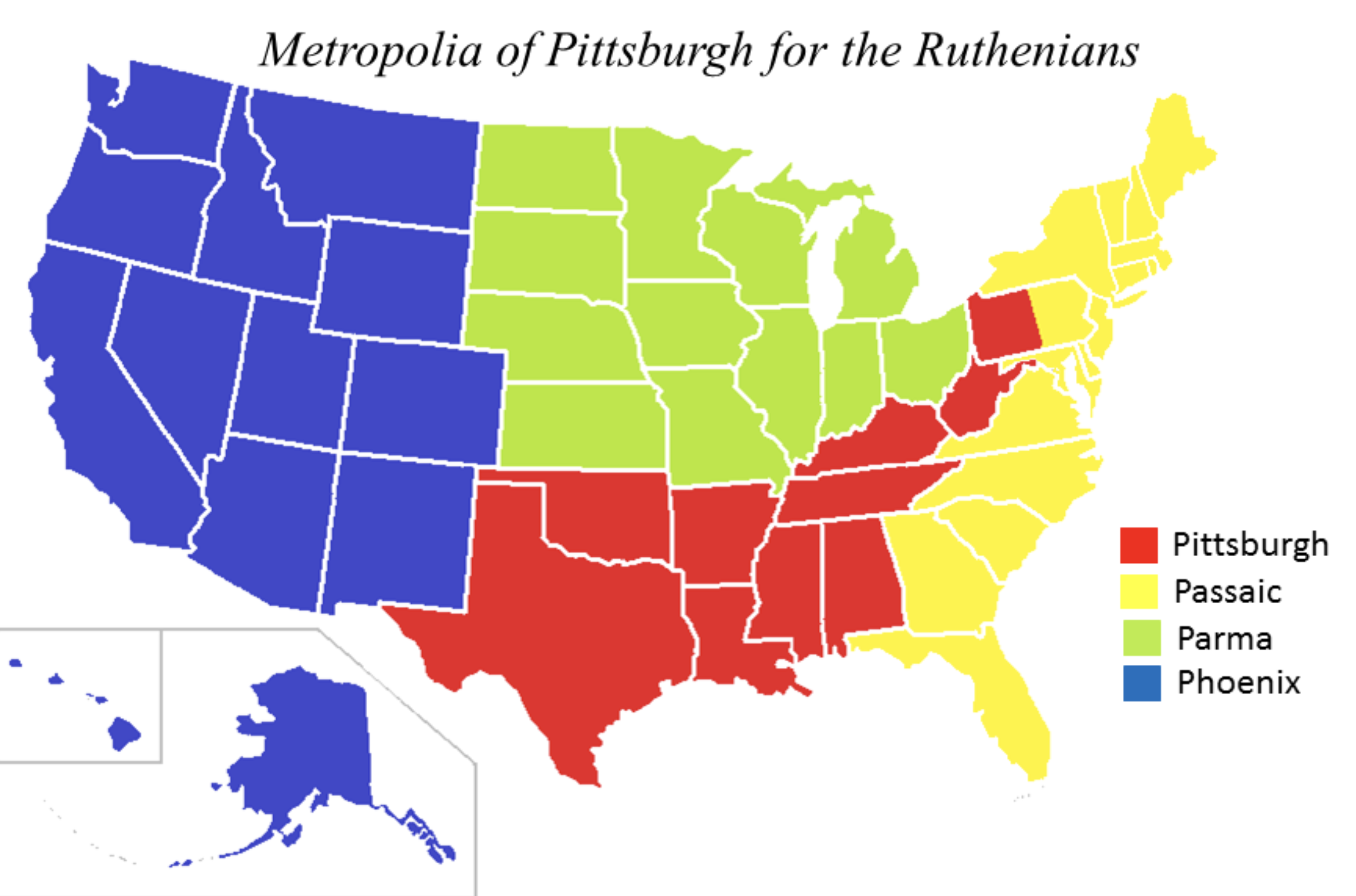
The North American jurisdictions of the Ruthenian Byzantine Catholic
Church — and a directory of the other Eastern Catholic Churches that
share full communion with Rome and a presence in the United States.
The Ruthenian Byzantine Catholic Metropolia of Pittsburgh
The Byzantine Catholic Church in the United States is organized as the
Metropolitan Church sui iuris of Pittsburgh —
a self-governing Eastern Catholic Church in full communion with the
Pope, with its own hierarchy, liturgical tradition, and pastoral
autonomy. Established in 1969 when the Holy See elevated Pittsburgh to
Metropolitan status, it is the only Eastern Catholic Church
headquartered in the United States. Four eparchies (dioceses) cover
the country between them, and a fifth jurisdiction extends the
Byzantine Catholic pastoral reach into Canada.
The Metropolia of Pittsburgh also has pastoral care for Eastern
Catholic faithful in the United States who belong to sui iuris
Churches that do not maintain a separate US jurisdiction of their own.
For those Eastern Catholics whose own Church has no local hierarchy
here, the Metropolia is the natural ecclesial home.
The four US eparchies of the Metropolia of Pittsburgh.
Archeparchy of Pittsburgh
Metropolitan See
See
Pittsburgh, Pennsylvania
Established
1924 (Apostolic Exarchate); elevated to Metropolitan See in 1969
Coverage
Western Pennsylvania and a broad southern swath — West Virginia, Kentucky, Tennessee, Alabama, Mississippi, Louisiana, Arkansas, Oklahoma, and Texas
The Metropolitan See of the Ruthenian Byzantine Catholic Church in America. When the Holy See established the Metropolitan Province in 1969, Pittsburgh became the mother church of an autonomous (sui iuris) Eastern Catholic body — the only Eastern Catholic Church headquartered in the United States.
Woodland Park, New Jersey (cathedral in Passaic, NJ)
Established
1963
Coverage
Eastern seaboard from Maine to Florida — Eastern Pennsylvania, New Jersey, New York, all of New England, the Mid-Atlantic, the Carolinas, Georgia, and Florida
Covers the eastern half of the United States. Serves a wide diaspora that includes both historic Carpatho-Rusyn families and new converts of every background.
1981 (originally as Eparchy of Van Nuys, California); seat transferred to Phoenix in 2010
Coverage
The American West — Arizona, California, Nevada, Utah, Colorado, New Mexico, Oregon, Washington, Idaho, Montana, Wyoming, plus Alaska and Hawaii
Covers the American West. Originally established with its seat in Van Nuys, California; the seat was transferred to Phoenix in 2010 to better serve the church's westward growth.
1980 (as Apostolic Exarchate); elevated to Eparchy in 1996
Coverage
Byzantine Catholic faithful of Slovak and Carpatho-Rusyn heritage throughout Canada
Extends the Byzantine Catholic pastoral reach across the Canadian border. Serves both Slovak and Carpatho-Rusyn Byzantine Catholics throughout Canada — the two peoples whose Byzantine Catholic heritage traces back to the same Union of Uzhorod (1646).
The Other Eastern Catholic Churches in the United States
The Catholic Church is a communion of twenty-four self-governing
churches: one Latin (Roman) Church and twenty-three Eastern Catholic
Churches. The Ruthenian Byzantine Catholic Church is one of those
twenty-three. Most of the others also maintain jurisdictions in the
United States, listed below. All share full communion with the Pope,
and Catholics in good standing may worship at any of them.
Many parishes welcome curious visitors. Worship styles, languages, and
cultural expressions vary widely between these churches — but the
underlying faith is one.
Ukrainian Greek Catholic Church
Descended from the Union of Brest (1596). The largest Eastern Catholic Church by membership worldwide.
Metropolitan Archeparchy of Philadelphia (Philadelphia, PA)
Eparchy of Stamford (Stamford, CT)
Eparchy of St. Nicholas of Chicago (Chicago, IL)
Eparchy of St. Josaphat in Parma (Parma, OH)
Melkite Greek Catholic Church
Antiochian patrimony, Arabic-speaking heritage, in full communion with Rome since the 18th century.
Eparchy of Newton (Methuen, MA)
Maronite Catholic Church
Originally Syriac-Antiochian; has been in continuous communion with Rome since at least the 12th century.
Eparchy of Saint Maron of Brooklyn (Brooklyn, NY)
Eparchy of Our Lady of Lebanon of Los Angeles (Los Angeles, CA)
Chaldean Catholic Church
Mesopotamian patrimony, descended from the ancient Church of the East; in communion with Rome since 1552.
Eparchy of Saint Thomas the Apostle of Detroit (Southfield, MI)
Eparchy of Saint Peter the Apostle of San Diego (El Cajon, CA)
Syriac Catholic Church
West Syriac tradition; in communion with Rome since 1781.
Eparchy of Our Lady of Deliverance of Newark (Bayonne, NJ)
Syro-Malabar Catholic Church
East Syriac tradition rooted in the apostolate of St. Thomas in India; in continuous communion with Rome since 1599.
Eparchy of Saint Thomas the Apostle of Chicago
Eparchy of Saint Thomas Apostle of Melbourne (jurisdiction extends to US in some pastoral matters)
Syro-Malankara Catholic Church
West Syriac (Antiochian) tradition in India; entered communion with Rome in 1930.
Eparchy of Saint Mary, Queen of Peace of the United States and Canada (Elmont, NY)
Romanian Greek Catholic Church
Byzantine tradition with Latin-influenced elements; entered communion with Rome in 1700.
Eparchy of Saint George's in Canton (Canton, OH)
Armenian Catholic Church
Distinct Armenian liturgical tradition; in continuous communion with Rome since the Crusades, formalized 1742.
Apostolic Exarchate for the United States and Canada (New York, NY)
Pre-launch note: bishop names, see-city addresses, and eparchy website
URLs change over time. Information here is current to the best of our
knowledge — please verify against the individual eparchy websites
before relying on any specific detail. Updates and corrections welcome
via the contact page.