In Part 1 of this series we traced the medieval backstory — the failed Union of Florence in 1439, the fall of Constantinople in 1453, the surprisingly durable Ruthenian unionate continuity under Metropolitan Gregory the Bulgarian, and the eventual splintering of the Rusyn-speaking world into four distinct populations by 1460. Each of those four populations was now on its own trajectory.
This article tells what happened to two of them — the Rus of the Duchy of Ruthenia centered on Kyiv, and the Rus of Red Ruthenia / Galicia — both within the Polish-Lithuanian Commonwealth. By the late 1500s they would jointly produce the Union of Brest, the first of the modern Eastern Catholic unions. And the catastrophic seventeenth century that followed would, in retrospect, be the period in which a distinctively Ukrainian identity was forged — born partly of war, partly of Cossack culture, and partly of the very tensions Brest had tried to resolve.
Setting the Stage
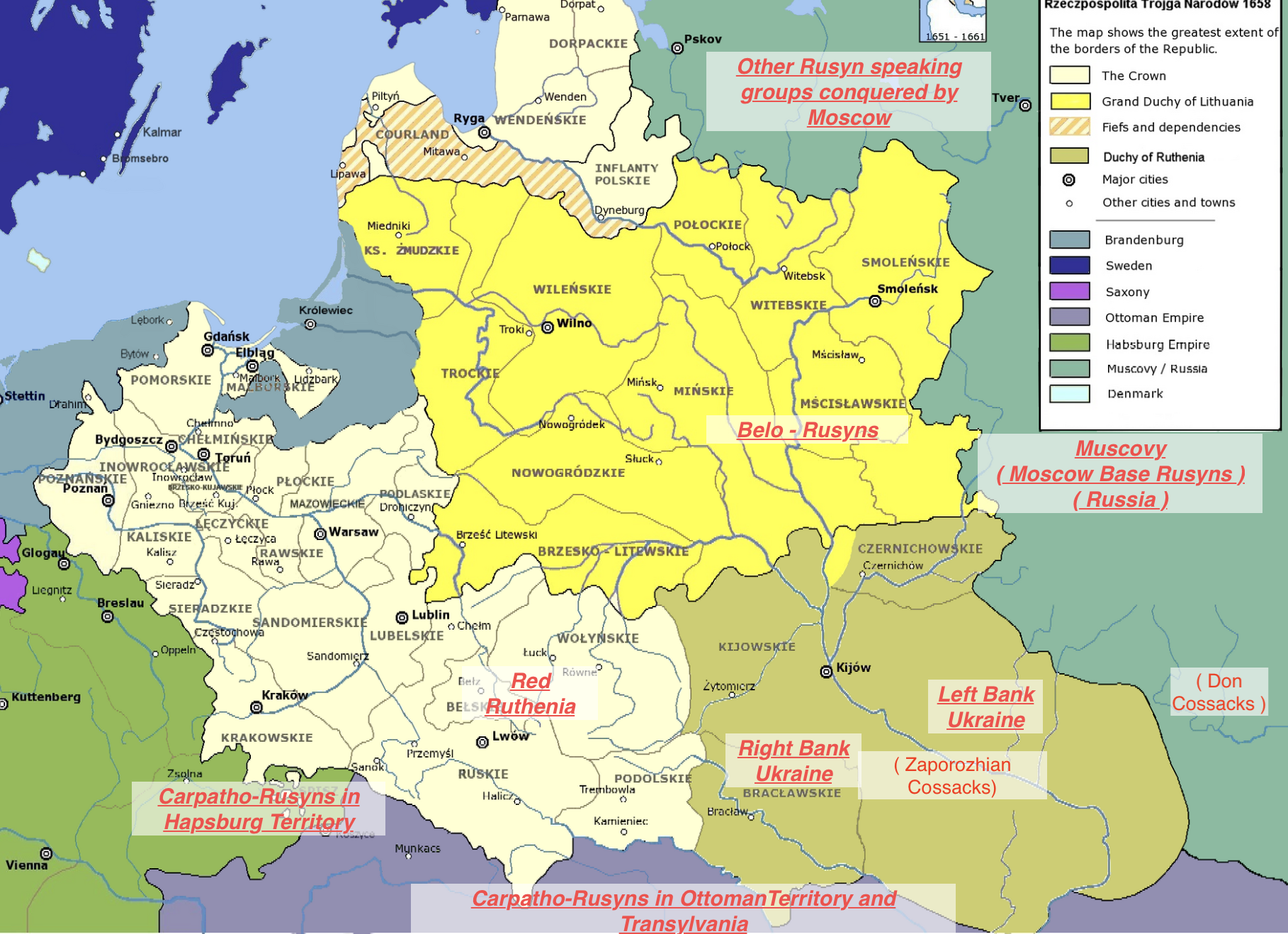
By the early 1500s, with Florence effectively dead and Constantinople under Ottoman administration, the Rusyn-speaking world was divided four ways. Far to the east, the Muscovite Rus — by now consolidating around an increasingly self-confident Russian Orthodox identity — claimed spiritual leadership over all the Rus lands, even those it did not politically control. To the west, two Rus populations lived under the Polish-Lithuanian Commonwealth: the Rus of the Duchy of Ruthenia centered on Kyiv, and the Rus of Red Ruthenia / Galicia, who had been blending with Polish Catholic culture for over a century. (A fourth population, the Carpatho-Rusyns west of the mountains, was on a different track entirely — that’s the subject of Part 3.)
Within the Commonwealth, the Galician and Kyivan Rus together formed what was institutionally the Kievan Metropolia, under Constantinople’s jurisdiction at least on paper. In practice the Metropolia was increasingly squeezed.
The Squeeze
By the late 1500s, the Ruthenian Orthodox church found itself in an increasingly difficult position. To the east, Moscow’s rulers had taken the title “Tsar of all the Rus-yas” — Tsar of all Russia — claiming sovereignty over every land that had ever been part of Kievan Rus, and aggressive military campaigns followed. To the west, Polish-Lithuanian Catholic culture was applying steady pressure on the Orthodox Ruthenian population: Polonization of the nobility, Latinization of liturgical practice in mixed regions, and a general sense among Polish Latin Catholics that the Orthodox were second-class members of the Commonwealth.
Internal reform efforts by some Ruthenian bishops collided with powerful lay brotherhoods (the stauropegic institutions answering directly to Constantinople) who resisted episcopal authority. And the long-distance authority of Constantinople itself was felt as increasingly remote and unreliable. When Patriarch Jeremias II of Constantinople visited the Commonwealth in 1588-1589, he asserted his authority by deposing the existing Metropolitan of Kyiv and appointing his own candidate, leaving many local bishops resentful.
It was in this context that the Ruthenian bishops themselves — not Rome, not the Commonwealth’s king, but the bishops of the Kievan Metropolia — began to consider whether a renewed union with Rome might offer what their increasingly fragile situation needed: legal parity with Latin Catholics, protection from both Polonization and Moscow’s encroachment, and the institutional support of a worldwide church. They were, in effect, looking to revive the union that had once been a living reality under Gregory the Bulgarian’s metropolitanate a century earlier.
The Union of Brest, 1596
In December 1594, Bishop Cyril Terlecki announced on behalf of the Ruthenian episcopate that they intended to transfer their ecclesiastical jurisdiction from Constantinople to Rome. The terms were carefully negotiated. The Ruthenian bishops insisted on retaining the Byzantine Rite, the Julian calendar, the right to elect their own metropolitan and bishops, married clergy, and the entire body of their Eastern liturgical and disciplinary tradition. Two bishops — Hipatius Potii and Cyril Terlecki — traveled to Rome in late 1595 to present the terms. Pope Clement VIII accepted them. The Union of Brest was formally proclaimed at a synod in Brest in October 1596.
Unlike the Union of Florence — which had been negotiated between distant councils of theologians and patriarchs — the Union of Brest was driven from the ground up by the Ruthenian bishops themselves. This was a union of the Ruthenian church, on Ruthenian terms, for Ruthenian reasons. It created what was originally called the Uniate Church and is today known as the Ukrainian Greek Catholic Church. Its strongest base was in Red Ruthenia / Galicia, but it spread throughout Ruthenian Commonwealth territory.
The Union of Brest was not without internal resistance. Two bishops — Hedeon Balaban of Lviv and Mykhailo Kopystenskyi of Przemyśl — withdrew their signatures and led an Orthodox counter-movement, supported by powerful magnates like Prince Konstanty Wasyl Ostrogski and by the lay brotherhoods. In 1620, an Orthodox hierarchy was secretly re-established in the Commonwealth by Patriarch Theophanes III of Jerusalem, creating a parallel Orthodox structure that would compete with the Uniate Church for the next several decades. The Union of Brest did not heal the divisions among the Ruthenians of the Commonwealth — it formalized them.
But its long-term significance was profound: for the first time since Gregory the Bulgarian’s death in 1473, there was once again a substantial body of Eastern Christians in full communion with Rome, with their own bishops, their own liturgy, and their own institutional life. Florence, after a long detour, had finally borne lasting fruit.
What no one in 1596 could have foreseen was that the century after Brest would be one of the most catastrophic in the history of Eastern Europe — and that out of that catastrophe would emerge an entirely new national consciousness.
The Deluge
Between 1648 and 1699, the entire region from the Vistula to the Dnieper and across the Carpathians was engulfed in what Polish historiography calls the Deluge — a cascading series of wars that nearly destroyed the Commonwealth and permanently reshaped Eastern European identities. The cascade included the Khmelnytsky Cossack uprising beginning in 1648, the Russo-Polish War of 1654-1667, the Swedish Deluge of 1655-1660, the Polish-Ottoman War of the 1670s, and the Great Turkish War of 1683-1699. Alliances shifted constantly. At various points all the major regional powers — the Commonwealth, Muscovy, Sweden, the Ottomans, the Crimean Tatars, and a divided Cossack hetmanate — were either fighting one another or temporarily allied.
The Cossacks at the center of this story deserve a brief explanation. They were a semi-nomadic frontier people of mixed origins — predominantly Ruthenian peasants and runaway serfs who had adopted the steppe culture of the Turkic nomads whose territory they shared. The word Cossack itself derives from a Turkic root meaning roughly “free man.” Over generations they coalesced into a distinct military caste with limited self-government within the Commonwealth, in exchange for serving as soldiers on the southeastern frontier. They were Orthodox by religion, fiercely independent by disposition, and increasingly suspicious of the Catholic-Polish institutional order around them.
Years of cultural, religious, and political tension eventually exploded into open rebellion in 1648 under the hetman Bohdan Khmelnytsky. What began as a Cossack grievance over Polish noble abuses became, within a few years, a full-scale war of religious and ethnic identity — Orthodox Cossack against Catholic Polish noble, with the Uniate Church caught in the middle as a symbol of both. The uprising killed tens of thousands, devastated Jewish communities across the eastern Commonwealth (Khmelnytsky’s army carried out some of the worst pogroms in pre-modern European history), and fundamentally weakened the Polish-Lithuanian state.
In 1654, desperate for protection, Khmelnytsky concluded the Treaty of Pereyaslav with Tsar Alexis of Russia, placing the Cossack hetmanate under Russian protection. This was the moment Moscow had been waiting for — a legitimate claim to “reunite” the Rus lands under Tsarist rule. War with the Commonwealth followed immediately.
The Ruin and the Treaty of Andrusovo
Two outcomes of this period matter most for the long story.
First, the Treaty of Andrusovo in 1667 formalized a division: Left Bank Ukraine and the city of Kyiv passed to Russian control, while Right Bank Ukraine remained in the Commonwealth. The Cossack hetmanate was effectively split in two, with civil war erupting between pro-Russian and pro-Polish factions.
Second, the Ruin — the catastrophic depopulation of Right Bank Ukraine that followed. Pro-Russian Cossack forces under Hetman Samoylovych carried out the so-called Great Migration of 1678-1679, forcibly relocating tens of thousands of Right Bank inhabitants eastward and deliberately depopulating the region to weaken the pro-Polish position. Combined with Polish-Ottoman warfare, Tatar raids, and ongoing internal Cossack civil war, the result was that Right Bank Ukraine — once one of the more prosperous parts of the Commonwealth — was reduced to a depopulated wasteland by the 1680s.
This was the demographic event that fundamentally separated the eastern Rusyns of what is now central Ukraine from their cousins to the west. The Right Bank refilled slowly over the following century, often with settlers from other regions; the eastern population, gathered around Cossack culture and increasingly oriented toward Moscow, became the nucleus of what would later emerge as a distinct Ukrainian national identity. Their cousins further west in Galicia took a different path entirely.
What Almost Was: The Treaty of Hadiach
One revealing glimpse of how close this came to a different outcome is the Treaty of Hadiach in 1658 — a never-implemented compromise between Polish diplomats and Cossack leaders that would have transformed the Commonwealth into a tripartite federation, with a semi-autonomous Cossack principality centered on Kyiv joining Poland and Lithuania as the third constituent partner instead of an incorporated territory.
The treaty’s provisions reveal how distinct the eastern Ruthenian self-understanding had already become:
- Only Eastern Orthodox could hold office in Cossack lands.
- No Commonwealth troops could be stationed there outside emergencies without local approval.
- The Union of Brest would be cancelled within Cossack territory.
The treaty was never ratified. War overtook it. But its provisions show plainly that by the mid-1600s, the eastern Ruthenians had begun forming a national consciousness with priorities — Orthodox identity, autonomy from the West, suspicion of the Uniate union — that would not be shared by their western cousins.
The Birth of a Ukrainian Identity
The seventeenth century was, in retrospect, the period in which a distinctive eastern-Slavic identity took shape that we would eventually call “Ukrainian.” Three forces fused: Cossack military culture with its origins in the steppe frontier; Orthodox religious self-understanding sharpened by the conflict with the Uniate Church; and resistance to Polish political-Catholic-cultural domination. These elements would coalesce only gradually — the term “Ukrainian” itself would not become standard for another two centuries — but the seeds were planted in the Deluge.
By the time the modern Ukrainian national movement crystallized in the 1800s, it would inherit a clear theological self-understanding from this period: Orthodox, not Uniate; politically suspicious of the West; rooted in the Cossack hetmanate’s brief but memorable experiment in self-rule.
The Galician Greek Catholics, oddly, would also eventually be folded into this Ukrainian national identity in the late nineteenth and early twentieth centuries — but only after a long detour. Under Habsburg Austrian rule after the 1772 Partition of Poland, Galician Greek Catholics enjoyed a century of imperial patronage that gave them institutions, education, and cultural infrastructure their Russian-ruled cousins were denied. By the time a modern Ukrainian national identity began to be articulated in the 1840s and after, the Galician Greek Catholic clergy were among its leading exponents — and the Ukrainian Greek Catholic Church became, in effect, the institutional spine of Ukrainian Galician identity. The Union of Brest, once the symbol that Cossack rebels had tried to abolish at Hadiach, ended up becoming the religious home of a substantial part of the people whose ancestors had wanted it gone.
The eastern Right Bank refilled with people who held no such allegiance. To this day, the religious geography of Ukraine still bears the print of the Deluge: a Greek Catholic west grounded in Brest, an Orthodox center and east grounded in the Cossack-Russian inheritance, and a long internal conversation about which version of Ruthenian Christianity is most authentically Ukrainian. That conversation is still ongoing.
Looking West
This was the story of what happened to the eastern Rus — the populations under Polish-Lithuanian rule, in the path of the Cossack uprisings, increasingly oriented toward an Orthodox-Cossack-Ukrainian self-understanding.
Meanwhile, on the western side of the Carpathian Mountains, a different Rusyn population had been having a completely different historical experience. They were not in the Commonwealth. They had no Cossacks. They were largely untouched by the Mongol invasions. The Deluge did not reach them. And so when their own Union with Rome eventually came — at Uzhorod in 1646, the year before Khmelnytsky’s uprising began — it was a different kind of union, made under different conditions, by a different people, on its way to a different future.
That is the story of Part 3 of this series.