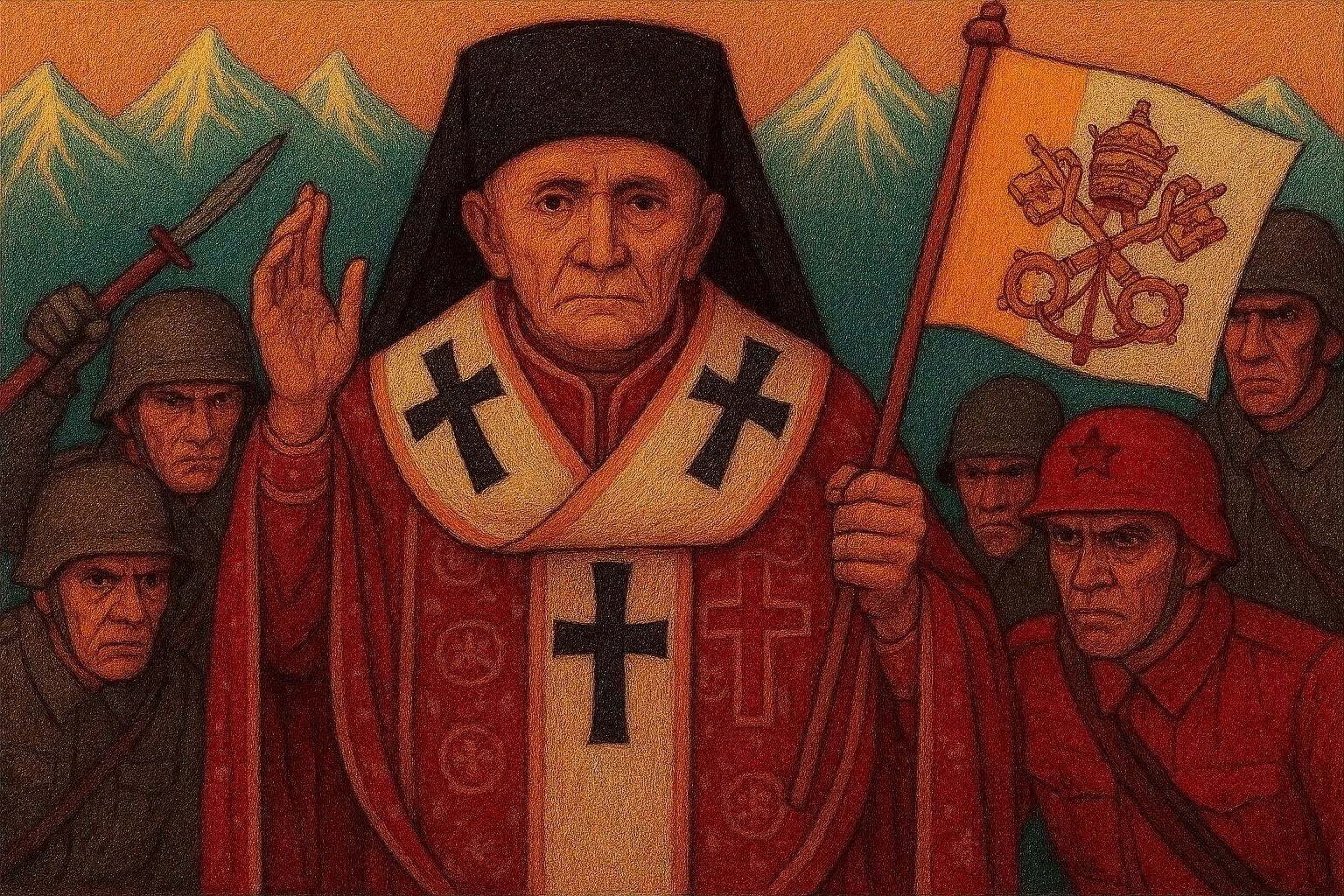
“I am certain that at the end truth will triumph over lies, and love will overcome hatred. I do not hate my enemies. I would like to bring them closer to Christ — of course not by force or deceit, but by love and truth.”
— Blessed Pavel Gojdič
In the winter of 1950, a man sat in an interrogation room in Czechoslovakia and was offered almost everything a man could want.
He could keep his freedom. He could keep his rank — more than his rank; he was offered elevation, a place at the head of a national church, honor and security for the rest of his days. The regime that held his people in its fist was prepared to be generous. All he had to do was sign a document renouncing his communion with the Bishop of Rome, and lead his flock, as hundreds of thousands of Eastern Christians were even then being led at gunpoint, out of the Catholic Church and into a state-controlled Orthodoxy.
He was sixty-two years old. He had spent his life serving one of the smallest and most overlooked peoples in Europe. He knew exactly what refusal would cost — he had already watched it cost others everything. He refused anyway.
His name was Pavel Gojdič. He was a Basilian monk, the Ruthenian Rite Greek Catholic bishop of Prešov, and by the reckoning of almost everyone who knew him, a living saint. Ten years after that interrogation, he would die on a concrete prison floor, on his seventy-second birthday, his health broken, his name slandered, his church legally abolished. And he would die, as he had lived, in full communion with Rome.
This is the story of why he would not sign — and of what it means that he didn’t.
A son of the mountains
To understand Gojdič, you have to understand the people he came from — because his whole life was bound up with theirs, and their fate and his cannot be told apart.
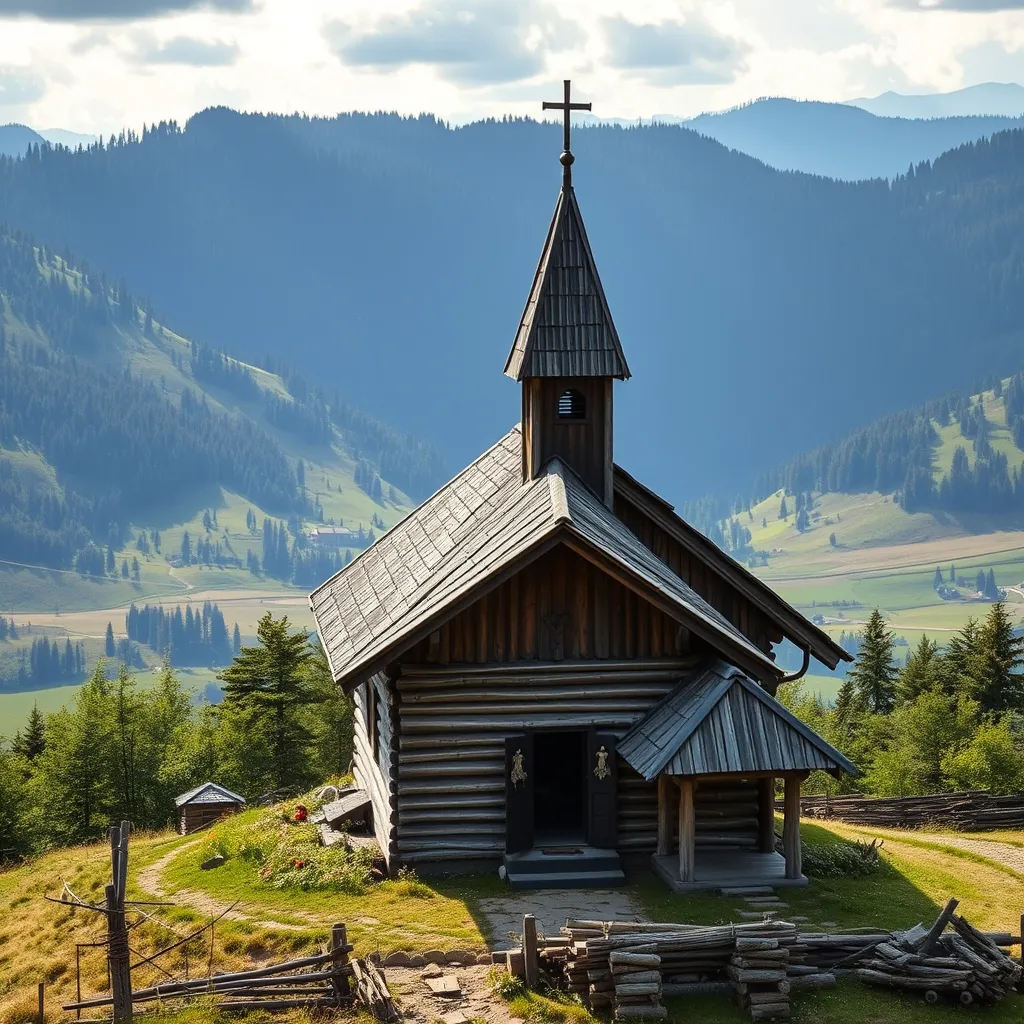
He was born Peter Gojdič on July 17, 1888, in the village of Ruské Pekľany, in the hill country near Prešov, in what was then the northeastern corner of the Kingdom of Hungary. He was a Carpatho-Rusyn — the Slavic people of the Carpathian mountains and central Europe, whose villages ran from southern Poland through what is now eastern Slovakia and Subcarpathian Ukraine, spilled down into the plains of northeastern Hungary, and reached as far south as the Vojvodina in present-day northern Serbia. The Rusyns, also known as Ruthenians and Rusniaks, are one of the peoples most Europeans have never heard of, though they have lived in the same mountains for more than a thousand years. They never had a state. They never had an empire, or a national army.
What they had instead was a language of their own, a dense web of village and kin, and above all a Church: the Ruthenian Rite Greek Catholic Church, simply known now as the Byzantine Catholic Church in its American territories; Eastern in every rite and prayer and chant, yet representing the fullness of unity of Faith by being in communion with Rome. This church, centered on Mukachevo, was the heart of a large, dynamic, multi-ethnic community of Greek Catholics west of the Carpathians that transcended national borders — the Slovak, Romanian, and Hungarian Greek Catholic Churches all grew out of, and kept their spiritual home in, the mother church at Mukachevo.
Gojdič was born into the priestly heart of that world. His father was a Ruthenian Rite Greek Catholic priest and the boy grew up in a rectory, inside the rhythm of the liturgical year. It was assumed he would follow his father to the altar, and he did. He studied for the priesthood, was ordained in 1911, and served for a decade as a parish priest and administrator, moving through the ordinary work of a young cleric: baptisms, confessions, the burial of the dead, the endless quiet labor of a country parish.
And then, in 1922, at the age of thirty-four, he did something that surprised the people who knew him. He gave it up — the parish, the ordinary path, the settled life — and entered the monastery.
The heart of gold
He joined the Order of Saint Basil the Great — the Basilians, the great monastic order of the Byzantine Church — and took a new name in religion: Pavel, Paul. It is worth pausing on the choice. A man does not leave a comfortable and respected position at thirty-four to become a novice among younger men unless something in him is reaching for more than respectability. Gojdič wanted to belong wholly to God, without the divided heart that ordinary life imposes. He wanted to be poor. By every account, he got his wish, and kept it to the end; even as a bishop he lived with a plainness that embarrassed visitors who expected more.
He did not stay hidden in the monastery for long. Rome had been watching the Prešov eparchy — one of the main Greek Catholic eparchies that shepherded the Rusyns on the southern slopes of the Carpathians — and in 1927 the young monk was pulled out of his cell and made its apostolic administrator. That same year he was consecrated a bishop in Rome. He chose for his episcopal motto a single line, and it is the key to everything that followed: “God is love — let us love him.”
It was not a slogan. It was a description of how he governed. Gojdič became, in the memory of his people, the bishop with the heart of gold — and the phrase was not sentimental. He poured the resources of his office into the poor. He founded and funded orphanages, and was known to visit the children himself, to learn their names, to sit with them. He built up schools and supported struggling parishes. He gave away what came to him. When people came to the bishop’s residence in need, they were not turned away, and the bishop’s own accounts stayed thin because of it. There is a particular kind of holiness that is undramatic almost to the point of being invisible — the holiness of a man who simply, relentlessly, over decades, treats every person in front of him as though they mattered infinitely. That was Gojdič. Long before anyone imagined a prison cell or a show trial, the people of Prešov already regarded their bishop as a saint, for the plainest of reasons: he loved them, and they could feel it.
In 1940 Rome named him the full residential bishop of Prešov. He was now one of the shepherds of the Rusyn Greek Catholics — the visible head of the institution that held his people together across borders. He would hold that office through the two darkest decades his people had ever known, and it would make him a target twice over.
The first battle: the Nazi regime
The first came in the shape of the Third Reich.
When Czechoslovakia was dismembered in 1939, each of its three parts suffered different fates. The autonomous Carpatho-Rusyn land to the east — which had just declared its own independence — was wiped off the map almost at once, invaded and annexed by Hungary. The “Czech” part was incorporated into Germany. The only remaining part, Slovakia, which held a surviving Rusyn minority in its eastern counties, emerged as a nominally independent state — but in reality a puppet of Nazi Germany. Its president, a Catholic priest named Jozef Tiso, stands in sharp contrast to Gojdič: he chose collaboration, presiding over a state that allied itself with Hitler, passed its own anti-Jewish laws, and deported tens of thousands of its Jewish citizens to the death camps. Tiso is the shadow that stands behind Gojdič’s whole story — the man who shows what collaboration looked like, and what a churchman could become if he decided that the survival of his position was worth the price of his soul.
Gojdič chose the opposite road, and he chose it quietly, at real risk. The Jews of Slovakia were being stripped of their rights and marked for deportation. One of the few things that could shield a Jew from the machinery of death was documentation showing Christian baptism. Gojdič, and the priests under him, issued baptismal certificates to Jews who came to them — papers that could mean the difference between a deportation train and survival. He was not alone in this across occupied Europe, but he did it knowingly, in a state whose government wanted those people gone, and every certificate was a small act of defiance against a regime that murdered people for less.
He also refused, throughout the war years, to let his office become an instrument of the nationalisms churning around him. Pressure came from several directions to bend the Rusyn Church to political ends — to redefine his people, to align them with one faction or another. He would not. His concern was the flock in front of him: their sacraments, their orphans, their safety. When the war ended, Gojdič had kept his hands clean in a time and place where a great many powerful men had not. He had been offered the collaborator’s bargain — comfort and security in exchange for looking away — and he had declined it.
He must have hoped the worst was behind his people. It was not. The worst was only changing uniforms.
The second battle: the Communists
In 1948 the Communists seized full control of Czechoslovakia, and the Greek Catholic Church moved to the very top of the list of things to be destroyed.
To understand why, you have to understand what the Church represented to the new regime. A Byzantine Catholic is, by definition, an Eastern Christian loyal to Rome — and Rome, to the Soviet mind, was the great foreign enemy, the Vatican that stood outside and above the reach of the state. Stalin would tolerate nothing short of state-controlled Orthodox churches across his territories. This painted a target on the two defiant Rusyn-speaking Greek Catholic peoples newly within his sphere of influence. The Soviet response would be paced and methodical.
Ukrainian-Galician Assimilation
In 1946, at the coerced “Synod of Lviv,” the Soviet authorities had simply abolished the Ukrainian Greek Catholic Church by decree, forcing its millions of members into the Russian Orthodox Church — an institution the state could control from the inside. The Ukrainian Catholics who resisted were imprisoned, deported, or killed. Galicians living here who had held out hope of a Galician state separate from Ukraine were finally rooted out. The question of any Rusyn state other than a Communist-supported Ukraino-centric one was forever stamped out.
Carpatho-Rusyn Assimilation
In 1947 the same script was run in the Rusyn lands of Subcarpathia — annexed by Hungary during the war, and by then swallowed into the Soviet Union itself. Bishop Theodore Romzha, the leader of the Rusyn Greek Catholics in that area, was assassinated — poisoned by the same kind of poison the KGB would later use on high-level political targets, on the direct orders of Khrushchev himself. Rusyn Greek Catholics in the region were deported, killed, and whitewashed from history. With one of the top Rusyn leaders out of the way and the population thoroughly reduced, any thought of an Uzhhorod-based national uprising was stamped out.
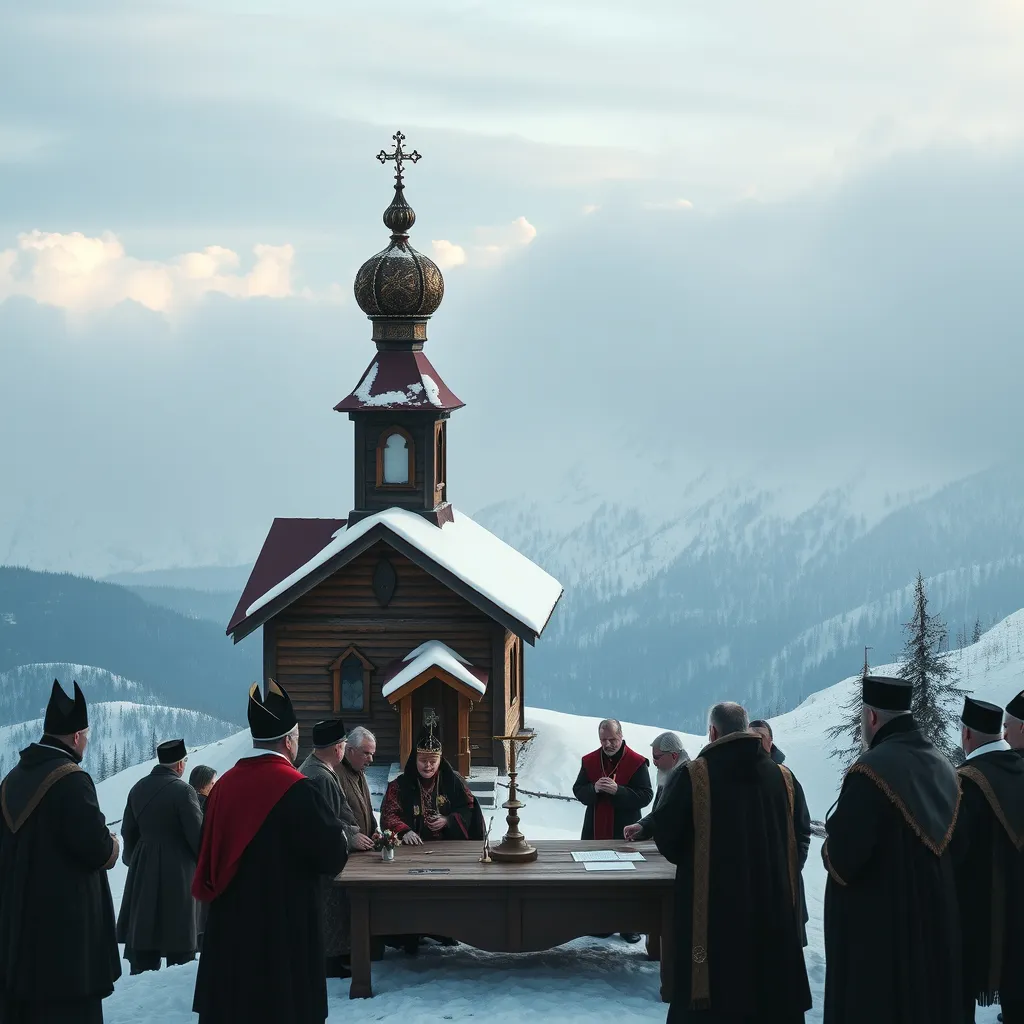
The same pattern happened in the Rusyn-inhabited regions of Slovakia where Gojdič presided. The instrument was a staged assembly held at Prešov on April 28, 1950 — remembered as the “Prešov Sobor.” A handful of pressured clergy, surrounded by the apparatus of the state, declared the Union of Uzhhorod dissolved. With a stroke, the centuries-old choice of the Rusyn people was annulled from above: the Greek Catholic Church was declared to have “returned” to Orthodoxy — though the hand behind the decree was never the Orthodox Church herself, but the atheist state using her as a mask. Its parishes, its cathedrals, its property, its very legal existence were handed to a state-supervised Orthodox administration. On paper, the Ruthenian Rite Greek Catholic Church had ceased to exist. And the Rusyn people were persecuted and reduced in population, with the few survivors left simply trying to endure the new regime.
But a Church is not only paper, and the regime knew it. A forced union that the bishop denounced would fool no one; a forced union the bishop blessed might actually hold. Gojdič — perhaps the last remaining visible leader of the Rusyn people — was the one man who could do this. If he could be turned — if the beloved bishop with the heart of gold could be brought to lead his people across the line himself — then the fiction would become fact, and the Rusyn Church would die not as a martyr but as an apostate.
So they made him the offer.
The precise words are lost to the interrogation rooms, but the shape of the bargain is well attested in the memory of his Church. Renounce Rome, and everything changes. Not only would the pressure lift; he would be honored. He was given to understand that a high place awaited him in the new Communist-run Orthodox order — in which every nation was given its own autocephalous, state-controlled church — by some accounts, leadership of the very national church they were building on the ruins of his own. He could walk out of that room a free man and a prince of the new church, rather than a prisoner. All it would take was his signature on the renunciation of the one communion he had given his life to keep.
Set the temptation in its fullest form, because Gojdič surely saw it in full. Signing could be dressed up as saving his people. If he led them into the state Orthodox church himself, the parishes might stay open. The orphans he loved might keep their roof. The bloodletting might stop. The deportations to Siberia might be revoked. He could tell himself that a living church under Moscow’s supervision was better than a dead one under Rome’s banner — that fidelity to a far-off pope was a luxury his small, battered people could no longer afford. A more calculating man could have built an entire theology of survival out of that single signature.
He refused.
He would not renounce his communion with the successor of Peter. He would not lead his flock into a lie, even a lie that promised to keep them warm. To every inducement and every threat he returned the same answer, and it never changed: he was a Catholic bishop, and he would remain one. If that meant prison, then he would go to prison. If it meant death, then he would die a Catholic. “So every one who acknowledges me before men, I also will acknowledge before my Father who is in heaven; but whoever denies me before men, I also will deny before my Father who is in heaven” (Matthew 10:32–33). Gojdič had read those words at the altar a thousand times. Now he simply did what they said.
The cell
What followed was the standard machinery of the age. Gojdič was arrested and, in January 1951, put on trial — not for the true offense of remaining Catholic, which no indictment could name aloud, but on the manufactured charges the era kept in stock: treason, espionage, working against the state. The verdict was written before the trial began. He was sentenced to life imprisonment.
The years that followed were meant to erase him. He was moved through the Communist prison system and held for long stretches at Leopoldov, one of the harshest prisons in the country. He was an old man in failing health, and the conditions were designed to break bodies and spirits alike: cold, hunger, hard labor, isolation, the calculated humiliation of a bishop stripped of everything but his name. Even there the offer is said to have followed him — the door was always open, if only he would recant. He never did. Fellow prisoners later remembered him as a source of strange peace inside that place, a man who heard confessions in whispers, who prayed without ceasing, who gave away his own scraps of food, who somehow went on being a shepherd in a place built to make shepherding impossible. The heart of gold did not tarnish in prison. It shone.
He was denied real medical care as his body failed. And on July 17, 1960, Pavel Gojdič died in his cell. It was his seventy-second birthday.
Consider what the regime believed it had accomplished. The bishop was dead and buried in a prison grave. His Church was legally abolished, its cathedral in other hands, its faithful driven underground or into the state Orthodox parishes. The Rusyn/Ruthenian people had been reduced to the point of extinction — and then further divided by Communist scholarship, which denied they were one people at all, reclassifying them into subgroups (Lemko, Boyko, Hutsul) and folding the whole into “Ukrainian,” so that any national reunification became impossible. On every measurable axis of power, the men who offered Gojdič the bargain had won, and the man who refused it had lost everything. That is what fidelity looked like from the outside in 1960: a corpse in Leopoldov and a Church wiped off the books.
At what cost
It is worth sitting, for a moment, with what Gojdič turned down — because the temptation was not crude, and pretending it was cheapens his refusal.
He was not merely offered his life. He was offered a way to tell himself he was saving his people. Across Eastern Europe in those years, this was the bargain the age held out to every leader of a small nation: bend, sign, collaborate, and you may keep something. Churchmen took it. Politicians took it. All around Gojdič, Ukrainian and Slovak and Czech and Polish men of influence made their peace with the new masters and were rewarded with survival, position, sometimes real power over their own people — always at the price of serving, in the end, the worldly powers that be. The men who signed did not all think of themselves as traitors. Many told themselves they were being realistic; that a compromised institution was better than a martyred one; that you cannot shepherd a flock from a prison cell.
Gojdič could have reasoned the same way, and with more justification than most, because his people were so small and so exposed. Play the hypothetical out to its furthest point. Suppose the price of his signature had been not just his own comfort but a genuine settlement for the Rusyns — recognition, a protected place, even some shadow of the nationhood they had never had. The Soviets were perfectly capable of manufacturing such a nation when it served them — as they had for the Belarusians after the First World War, and would again for the Moldovans a generation later: each cast as a nation of its own, with its own flag and tongue, so long as it answered to Moscow. Suppose he could have bought his people a country by signing. It would still have been the wrong trade, and he seems to have understood exactly why. A Carpatho-Rusyn nation purchased by renouncing the Byzantine Catholic faith would not have been the Carpatho-Rusyn nation at all. The faith was not one feature of that people among many; it was the spine. Centuries of Rusyn identity ran through that faith and its communion with Rome. To sign it away to save the body would have been to kill the soul and preserve the corpse — to hand his enemies the one victory they actually wanted, dressed up as survival. Better a people faithful and scattered than a people intact and hollow. Gojdič chose the faithful remnant over the soulless nation, and he chose it with his eyes open.
Vindication
The regime that buried him did not last. The Prague Spring of 1968 forced a partial legalization of the Greek Catholic Church, and the faithful — who had never really left, only gone underground — came back into the light in numbers that stunned the authorities. With the fall of Communism in 1989, the Church Gojdič had died for was fully restored: its cathedral returned, its parishes reopened, its life resumed. The thing that had been legally abolished simply refused to stay dead. It turned out that a Church is not paper after all.
In 2001, Pope John Paul II — himself a son of the same Communist night, from just over the mountains in Poland — declared Pavel Gojdič Blessed, a martyr for the faith. His relics rest today in the Greek Catholic cathedral in Prešov, in the city where he had governed and from which he had been dragged away. He is honored, too, outside the Church: the state of Israel recognized him in 2007 among the Righteous Among the Nations, for the Jews he sheltered when sheltering them was a crime. The man the regime tried to erase is now one of the most honored figures the Rusyn people have ever produced.
The bishop who would not renounce
There is a way of reading this story that is just downright sad — a good man crushed by a cruel century; found dead and alone on his birthday. But that is not how his own Church reads it, and it is not, I think, the truth of it. His story is one of victory over the worldly powers that mirrors Christ’s own victory over death. In an era where leaders were bending the knee to the worldly Communist machinations of the time, Bishop Gojdič stood his ground and was the rare exception.
Gojdič was offered the whole world twice, and twice he handed it back. He could have gained worldly advantage by collaborating with Hitler, but he did not. He could have kept his freedom, his rank, even a crown, under Stalin’s heirs by signing, and he refused. Everything the powers of his age could give or take away, they put on the table in front of him, and he treated all of it as weightless next to the one thing they could not touch: his communion with Christ’s Church, and through it with Christ. “Be faithful unto death, and I will give you the crown of life” (Revelation 2:10). He was, and the crown he received is not the one the regime offered him in that cold room.
His motto turned out to be his whole life, compressed into five words. God is love — let us love him. Not “let us survive.” Not “let us collaborate to save our skin.” Not “let us keep what we can.” Let us love him — to the prison, to the cold, to the birthday spent dying on a stone floor, and past it. A man who has actually believed that God is love has nothing left that the world can use as leverage. That is why Gojdič could not be bought. And that is why, sixty years after the state closed his file and thought the matter finished, we are still saying his name.
Blessed Pavel Gojdič, pray for us.