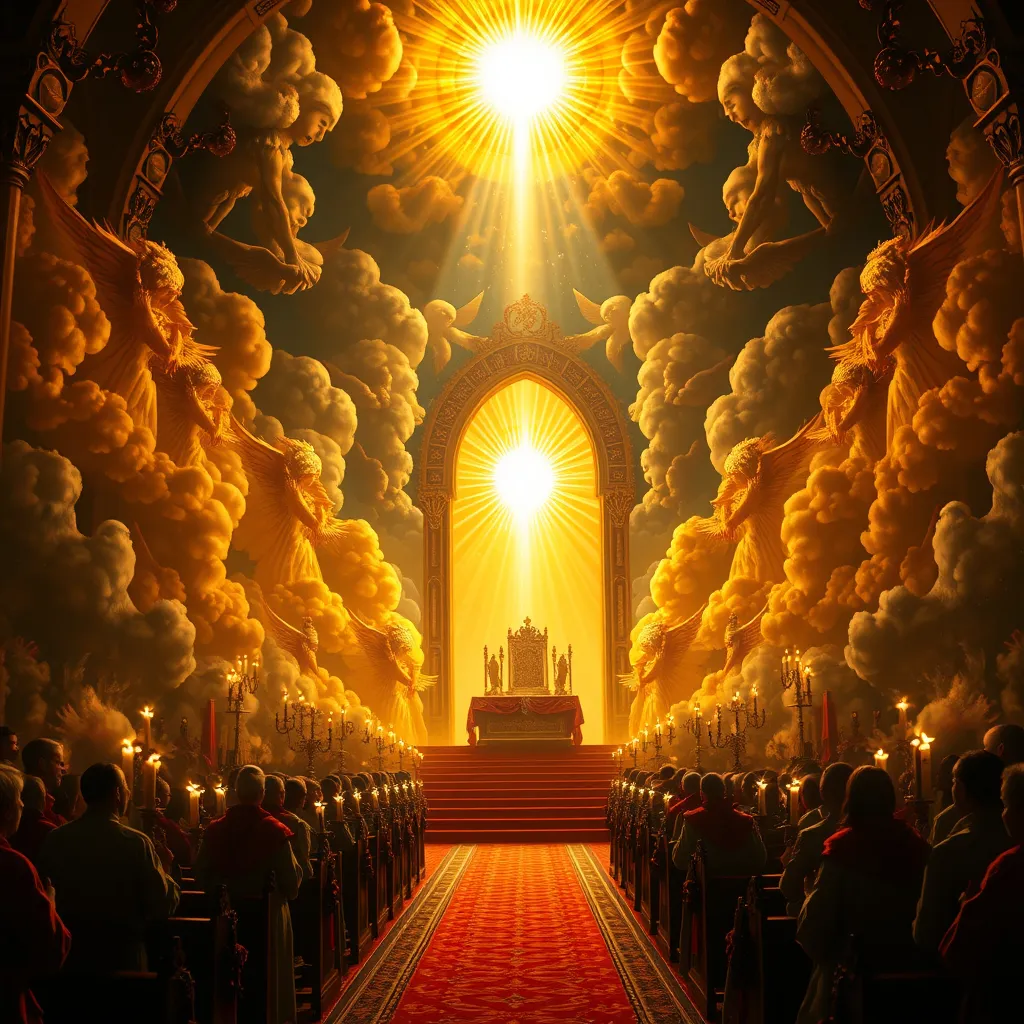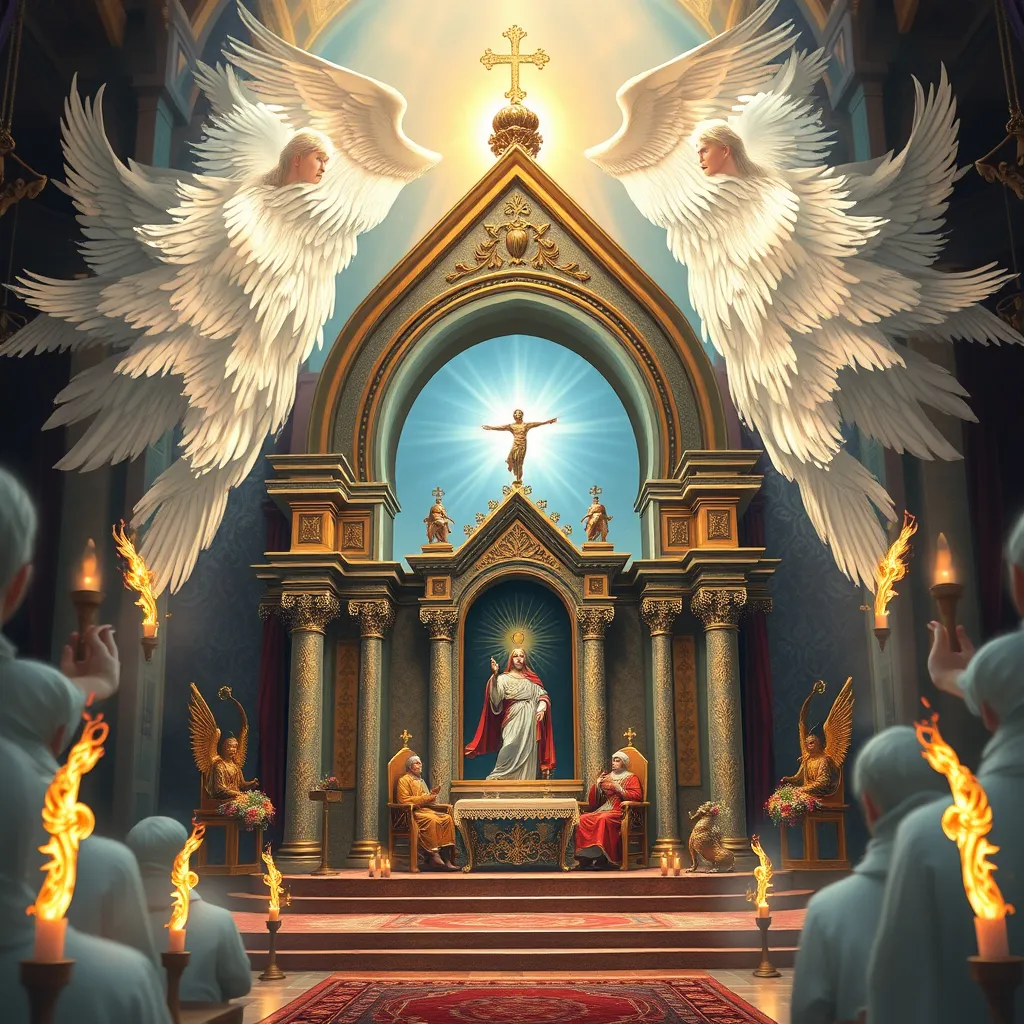
This is the last stop on the Core Faith path — and the one where everything else comes together. You have walked through what the Byzantine Catholic Church is and where it came from, what sin and death are and how Christ conquered them, why we honor Mary and the saints and surround ourselves with icons. All of it is gathered, every Sunday, into a single act of worship: the Divine Liturgy. So the series ends where a newcomer’s story often begins — standing in the back of a church, taking it in.
If you walked into a Byzantine Catholic Divine Liturgy for the first time, you might be struck by how unfamiliar it feels — the chanting, the incense, the icons, the bowing, the elaborate vestments, the procession. You might also wonder: where did all of this come from? Is any of it actually in the Bible?
The answer might surprise you. The Divine Liturgy is not a medieval invention or a Greek cultural overlay. Its essential structure and elements are scriptural — drawn directly from the Bible’s depiction of how God is worshiped in heaven, and especially from the New Testament Book of Revelation. This article walks through the Liturgy and shows where its pieces come from in Scripture.
How Ancient Christians Worshiped
The Book of Revelation opens with the Apostle John telling us he was “in the Spirit on the Lord’s day” (Revelation 1:10) — that is, on Sunday, the day of Christian worship. From that point on, the visions woven throughout the book repeatedly depict a worship service in extraordinary detail: an opened door into heaven, hymns sung antiphonally, prayers rising with incense, the reading of a sealed scroll, prostrations before the throne, white-robed figures with sashes, the Lamb at the center, and a great multitude joining in song.
You can read all of these intermittent visions of heavenly worship gathered together in The Worship of Heaven in the Book of Revelation.
There are two complementary ways to read this.
- That John was physically present at an early Christian Sunday service, and as he worshiped, he slipped in and out of prophetic trances — seeing the earthly liturgy in front of him perfectly aligned with the eternal liturgy taking place in heaven (compare 1 Corinthians 14:30-33 on prophecy in the church assembly).
- That just as the worship of the Old Covenant was patterned on what Moses was shown on the mountain (Exodus 25:9, 40; Hebrews 8:5), the worship of the New Covenant is patterned on what John was shown — and part of what is being “revealed” in Revelation is the true pattern of Christian worship. Christ’s instruction to John in Revelation 4:1 — “Come up here, and I will show you what must take place after this” — applies not only to the prophecies but to the worship itself!
Either way, the takeaway is the same: the worship depicted in Revelation isn’t background scenery. It’s the model.
The Witness of the Ancient Churches
You can also see this confirmed historically. The most ancient Christian traditions — those that trace their roots directly to the apostolic age — all share the essential shape of this worship. That includes the Ethiopian Orthodox Tewahedo Church, the Indian (Malankara) tradition, the Assyrian Church of the East (in modern-day Iraq, Iran, and beyond), the Coptic Church of Egypt, the Syriac Antiochene tradition, the Greek Byzantine Church, and the Latin Rite Church. Their liturgies look different in language and cultural expression, but the underlying pattern is unmistakably the same.
This matters because many of these churches developed largely independently of Rome — some splitting from the wider church as early as the 5th century, long before any of the medieval theological developments that shape modern negative caricatures of “Roman” worship. The shared shape of their liturgies cannot be dismissed as Roman influence, Pope-driven innovation, or “pagan accretion.” It is simply how ancient Christians worshiped, going back to the time of the apostles.
Different cultural expressions of the same underlying faith are perfectly valid — Christianity has never demanded liturgical uniformity. But the worship described in Revelation has a distinctive shape that the most ancient churches have all preserved: rich, sensory, participatory, and structured around the eternal worship taking place in heaven itself.
Why We Worship This Way
When we celebrate the Divine Liturgy, we are not putting on a separate earth-bound service. We believe we are joining the one eternal liturgy already underway outside of time in heaven. The angels and saints worshiping before God’s throne in Revelation are worshiping with us — or rather, we with them.
This isn’t simply our interpretation of what John saw. As John is taken up into heaven, Christ tells him explicitly: “Come up here, and I will show you what must take place after this” (Revelation 4:1). The Greek word for must (dei) carries the weight of divine necessity — the same word used in the Gospels when Christ says He must suffer, must be raised, must fulfill all that is written. What follows for the rest of Revelation isn’t decorative scenery. It is the worship that must take place — given by Christ Himself to John as the model for Christian worship.
This is why our liturgical traditions are so carefully preserved: when we sing what the angels sing in heaven, we want our song to actually match theirs. It’s also why a Divine Liturgy can theoretically be celebrated even with just one or two people physically present — the church is never really empty, because the saints and angels in heaven are always there.
The Letter to the Hebrews makes this point repeatedly: Christ has entered “the greater and more perfect tent” once and for all (Hebrews 9:11), and His sacrifice and worship are eternal (Hebrews 9:25-26; 13:8). Our earthly liturgy joins this heavenly one. We aren’t claiming this is the only legitimate way to worship — but we do believe it is the fullest expression of what worship was always meant to be.
Two Parts: The Liturgy of the Word and the Liturgy of the Eucharist
The Divine Liturgy has two main parts, and you can see this two-part structure foreshadowed throughout the New Testament.
In Luke 24, on the road to Emmaus, the risen Christ does something striking. First He explains the Scriptures to the disciples — “beginning with Moses and all the Prophets, He interpreted to them in all the Scriptures the things concerning Himself” (Luke 24:27). Then He sits down at the table, takes bread, blesses it, breaks it, and gives it to them — and at that moment “their eyes were opened, and they recognized Him” (Luke 24:31). Word, then bread. Scripture, then Eucharist. The disciples come to know Christ through both.
You see this same pattern in Acts 2. The earliest Christians worshiped twice: they would gather daily in the Temple (a synagogue-style service of psalms, prayers, and Scripture), and then they would gather privately in homes for the breaking of bread (Acts 2:46). This continued until they were eventually expelled from the synagogues (John 16:2). At that point, the two halves merged into the single Sunday service we know today as the Divine Liturgy.
The first half is called the Liturgy of the Word — focused on prayer, hymns, and the proclamation of Scripture. The second half is the Liturgy of the Eucharist (or “the breaking of the bread”) — focused on the offering and the reception of Communion.
These map roughly onto chapters 4-11 and 11-19 of Revelation respectively.
Let’s walk through both, with Scripture as our guide.
The Liturgy of the Word
The first part of the Liturgy was traditionally open to all — the baptized, the catechumens preparing for baptism, and any visitors who wished to attend.
Opening hymns and the opening of the gates
The service typically begins with singing — often a hymn related to the day’s Gospel reading or the feast being celebrated. The royal doors of the iconostasis open, echoing John’s vision: “After this I looked, and behold, a door standing open in heaven” (Revelation 4:1). At Christ’s death, the curtain of the Temple was torn from top to bottom (Matthew 27:51); in the Liturgy, this opening is enacted visibly.
Incense
Incense is offered around the church, recalling the smoke and lightning around God’s throne in Revelation 4:5 and the prayers of the saints rising as incense in Revelation 8:3-4 (see also Isaiah 6:2-4). For us, incense isn’t magical — it’s a physical reminder that we have entered God’s presence, and a visible image of our prayers rising like incense.
Prayers of supplication, the Trisagion, and “Lord have mercy”
The Liturgy is dense with prayer, in keeping with St. Paul’s instruction to pray “with all prayer and supplication… for all the saints” (Ephesians 6:18). Repeated cries of “Lord, have mercy” echo the tax collector’s prayer that Christ Himself praised as the right way to approach God (Luke 18:13-14). And variations of the Thrice-Holy hymn (“Holy, Holy, Holy”) draw directly from Revelation 4:8 and Isaiah 6:3. We sing what the angels sing.
Hymns and antiphonal singing
The Liturgy is sung from beginning to end. Different hymns celebrate God’s worthiness, echoing Revelation 4:9-11 and 7:9-12. Most of this singing is antiphonal — call and response between the priest at the altar, the deacon, and the cantor or congregation. This back-and-forth pattern is exactly what John describes throughout Revelation (4:9-11; 5:9-14; 7:9-12; 11:15-18; 16:5-7; 19:1-8).
The Little Entrance and the reading of Scripture
The Gospel book is carried in procession into the sanctuary, symbolizing Christ’s entrance into the world (compare Revelation 5:6-7, where the slain-yet-standing Lamb takes the scroll). We hold the Gospel in extraordinary reverence as the Word of God; the congregation makes the sign of the cross as it is paraded around with the priest holding it high for all to see. Then we read from one of the apostolic letters and from the Gospel — the New Testament’s explicit instruction that Scripture be read publicly in worship (Colossians 4:16; 1 Thessalonians 5:27; 1 Timothy 4:13). The “opening of the seals” in Revelation 5-7 is a vivid icon of this reading of God’s Word.
The homily / sermon
The priest preaches on the readings — explaining, applying, and inviting. John captures the bittersweet character of God’s Word in Revelation 10:9-10: the scroll is “sweet as honey” in the mouth but “bitter in the stomach.” The Word is delightful to hear but can be difficult to live.
The Liturgy of the Eucharist
In ancient practice, the second half of the Liturgy was reserved for the baptized. Catechumens were dismissed before the Eucharist began and would traditionally spend this time learning. This tradition has since disappeared; all are welcome during all points of the Liturgy!
Continued hymns and prayers
The pattern of singing and intercession continues, mirroring Revelation 11:15-19 and 14:1-7. We pray for the Church, for civil leaders, for the sick, the suffering, the traveling, and the departed (Ephesians 6:18). In the vivid imagery of Revelation, we see the angels in white robes and golden sashes (Revelation 15:6) — which liturgical tradition has long associated with the role of priests and deacons — pour out the bowls of prayers of intercession before God’s throne (Revelation 15:7-8; 16:5-7).
The Great Entrance
The bread and wine, prepared earlier, are now carried in procession to the altar. This Great Entrance evokes Revelation 19:11-16, where Christ rides forth in glory, and points forward to the new and eternal covenant established by His Body and Blood (Matthew 26:26-28).
The Nicene Creed
The whole congregation prays or sings the Nicene Creed — the joint statement of faith formulated in 325 AD and accepted by virtually all ancient Christian traditions. It is the Church’s confession, or public acclamation, of what we believe before we receive the Eucharist.
The Anaphora and the Words of Institution
The priest offers the great prayer of thanksgiving (the anaphora), recalling the saving work of Christ and asking the Holy Spirit to descend upon the gifts. The Words of Institution — Christ’s own words at the Last Supper — are spoken: “Take, eat; this is My Body… Drink of it, all of you; this is My Blood of the New Covenant” (Matthew 26:26-28).
The Our Father
The whole congregation prays the Lord’s Prayer (Matthew 6:9-13) — the prayer Christ Himself taught us — immediately before approaching Communion.
The commemoration of Mary
We honor the Theotokos — our Greek title for Mary, which means something like “Birth Giver of God” — as Mary herself prophesied: “From now on all generations will call me blessed” (Luke 1:48). She is named in the Liturgy as “more honorable than the cherubim and beyond compare more glorious than the seraphim.” But not above God.
Communion
After a group prayer of repentance, the faithful approach to receive the Body and Blood of Christ. The marriage supper of the Lamb in Revelation 19:9 and the great supper in Revelation 19:17 are present here in mystery — heaven and earth, the eternal banquet and the Sunday Liturgy, are not two events but one.
Dismissal and sending forth
Spiritually renewed (compare Revelation 20-21), we are sent out into the world to live what we have received and to share God’s love — much as Revelation closes with the call to bear witness (Revelation 22:10-11, 20-21).
The Elements of Worship
Several elements run throughout the Liturgy and are worth pausing on.
Singing
Worship in the Bible is almost always sung. The four living creatures sing without ceasing (Revelation 4:8). The redeemed sing a new song before the throne (Revelation 5:9-11). The great multitude sings “Hallelujah” (Revelation 19:1-8). St. Paul tells the Ephesians to address one another “in psalms and hymns and spiritual songs, singing and making melody to the Lord with your heart” (Ephesians 5:19-20; Colossians 3:16-17). For this reason, almost the entire Byzantine Liturgy is sung — by the priest, the deacon, the cantor, and the congregation.
Musical instruments — or rather, their absence
Scripture clearly shows musical instruments in heavenly worship (Revelation 5:8; 15:2-4; Psalm 150). Nevertheless, the Byzantine tradition does not use them in the Divine Liturgy. The reason is that the angels are continuously shown singing before the throne, and we consider unaccompanied human voice to be the fullest imitation of angelic worship. (Church bells, used to call the faithful and to mark moments in the service, might count as a partial exception.) This isn’t a condemnation of instruments — it’s a particular tradition rooted in a particular reading of how angels worship.
Incense
Incense appears throughout the heavenly liturgy (Revelation 5:8; 8:3-5; 15:8; Isaiah 6:2-4) and accompanies God’s presence in the Old Testament (Exodus 30:7-8). We use incense at the start of the Liturgy as a reminder that we have entered God’s presence; at the reading of the Gospel; and during prayers, since “the prayers of the saints” rise to God like incense. We hold that the moment incense is being offered is an especially appropriate time to silently offer our own prayers.
Antiphonal call and response
John’s visions show worship that is not a monologue but a dialogue — the elders speak, the multitude answers, the angels respond, the four living creatures cry out (Revelation 4:9-11; 5:9-14; 7:9-12; 11:15-18; 16:5-7; 19:1-8). The Byzantine Liturgy preserves this. The priest invokes; the people respond. The deacon calls; the cantor or congregation answers. Worship is a conversation across the whole assembled Body — not meant to be done in isolation but sung from the mountaintops in unity.
Bowing and prostration
The 24 elders fall down before the throne (Revelation 4:10; 19:4). The great multitude falls on their faces (Revelation 7:11). Bodily reverence is part of worship, not a peripheral add-on. In Byzantine practice, the faithful bow, cross themselves, and during certain seasons make full prostrations.
Palm branches
During Lent and certain feast days, palm or pussy-willow branches are blessed and held — echoing the great multitude before the throne “with palm branches in their hands” (Revelation 7:9).
“Lord, have mercy”
This simple cry, sung repeatedly throughout the Liturgy, is rooted in Christ’s teaching that the tax collector — who simply prayed “God, be merciful to me, a sinner” — went home justified, while the Pharisee with his elaborate self-praise did not (Luke 18:10-14). It is good to give thanks; it is even better to bow our heads in humility and ask for mercy.
The intercession of the saints
We ask the saints in heaven to pray for us, just as we ask living Christians to pray for us. Scripture treats the saints as living, conscious, and participatory in worship — Abel “still speaks” though dead (Hebrews 11:4); the elders offer the prayers of the saints to God in golden bowls (Revelation 5:8); St. Paul charges Timothy “in the presence of God and of Christ Jesus and of the elect angels” (1 Timothy 5:21). Asking their intercession is part of recognizing that the Body of Christ is not divided by death.
The Church Building Itself
The architecture of a Byzantine Catholic church is itself a scriptural argument.
The royal doors
The main doors of the iconostasis stay closed when the Liturgy is not being celebrated, recalling the gates of heaven that were closed before Christ’s coming. They are opened during the Liturgy in fulfillment of John’s vision (Revelation 4:1) and the torn Temple curtain (Matthew 27:51). When you walk in, you are walking through what Hebrews calls “a new and living way” (Hebrews 10:19-22).
The threefold structure: nave, sanctuary, holy of holies
The Tabernacle and the Temple were divided into three concentric zones, each separated by a curtain (Exodus 26:31-33; Leviticus 16:2; Hebrews 9:1-9):
- The outer court, accessible to ceremonially clean Israelites only.
- The Holy Place, accessible only to Levitical priests performing their duties.
- The Holy of Holies, accessible only to the High Priest, only once a year.
A Byzantine church preserves this same threefold structure, but transformed by Christ:
- The outer doors / narthex correspond to the first curtain. Because the veil was torn at Christ’s death, anyone may now enter a Christian church. (This is also why the front doors of many Byzantine and Orthodox churches are ornate or gilded — they are the “first curtain” still serving its purpose, but now opened to all.)
- The nave, where the congregation gathers, corresponds to the Holy Place. In the Old Covenant, only Levitical priests could stand here. In the New Covenant, the Christian people themselves are “a royal priesthood, a holy nation” (1 Peter 2:9), and so we sit and stand and pray in what was once forbidden territory. (In ancient practice, only the baptized could enter even the nave; catechumens waited in the narthex. That stricter discipline has long since relaxed.)
- The sanctuary, behind the iconostasis, corresponds to the Holy of Holies. Christ our High Priest is permanently and physically present here in the Eucharist (Hebrews 9:11-12, 24). The veil is torn — we can see in, and the priest enters during the service — but the space still retains its sanctity. Only those baptized and properly disposed enter (Hebrews 10:19-22). It is not a free-for-all; the openness of the New Covenant is not a denial of holiness.
Some Christian traditions read certain passages in Hebrews 9 to mean the sanctuary distinction has been abolished entirely. But Paul completes his entire line of thought in Hebrews 10:19-22, and there it’s clear: yes, we have access to the Holy of Holies through Christ — and yes, we approach with reverence, with bodies washed and consciences clean. The rule for it presupposes its continued existence.
Icons and the iconostasis
The walls and the iconostasis are covered with icons of Christ, the Theotokos, the angels, and the saints. This too is biblical: God’s throne in heaven is surrounded by living creatures, by the elders, and by the great cloud of witnesses (Revelation 4-5; 5:11; 7:9; 21:12-14; Isaiah 6:1-3). When we worship, we are surrounded by the same cloud. The icons make this visible.
The dome and the icon of Christ above
In ancient times, domes were a distinctly Christian architectural style, and something many surviving apostolic churches still employ. The dome almost always contains a large painted icon of Christ on the inside of it. The effect is that as you are standing in Liturgy, surrounded by paintings of saints, angels, and heavenly things — Jesus, the icon of God, is above all.
The altar
Our altar is hollow, recalling the souls of the martyrs who cry out “from under the altar” in Revelation 6:9. We still have an altar (Hebrews 13:10) and a sacrifice — but our sacrifice, as Hebrews makes clear, is now “a sacrifice of praise” through Christ (Hebrews 13:15-16).
The lampstand
A lamp burns continually before the altar — echoing the seven golden lampstands of John’s vision (Revelation 1:12) and the perpetual flame commanded under the Old Covenant (Leviticus 24:1-4).
Vestments
The priests and deacons wear bright linen garments and sashes, echoing the white-robed angels of Revelation 15:6 and the Son of Man Himself in Revelation 1:13. Ezekiel describes priests of the future covenant — the current “New Covenant” — who wear specific vestments for worship and remove them when leaving (Ezekiel 44:16-19), a pattern preserved in Byzantine practice today.
Cherubic imagery in the sanctuary
Carved or painted depictions of cherubim and seraphim around the altar reflect the four living creatures around God’s throne in Revelation 4:6-9 — and, before that, the cherubim that overshadowed the Ark of the Covenant (Exodus 25:18-22) and were carved throughout Solomon’s Temple (1 Kings 6:23-35).
The relative absence of pews
Ancient traditional Christian churches didn’t use rows of pews. This isn’t a rule, and many parishes today have adopted the innovation of pews for practical reasons. But it’s worth noting that the worshipers in Revelation are repeatedly shown falling on their faces before the throne (Revelation 4:10; 7:11; 11:16; 19:4) — which is a great deal harder to do from a pew. This is also why, during certain services — Lenten weekday services for instance — you may see people avoiding the pews entirely, or sitting only near the aisle.
Come and See
What looks at first glance like elaborate, superfluous ceremony is, on closer inspection, the Bible’s own picture of worship preserved in continuous practice for two thousand years. The incense, the chant, the bowing, the icons, the sanctuary curtain torn open, the Lamb on the altar — all of it is in Scripture, and most of it is revealed to us in Revelation specifically.
If you’ve never experienced a Divine Liturgy, the best advice is the simplest: come and see. Stand quietly in the back, take it in, and read along in the Bible afterward. You may be surprised how much of what you witnessed you can find on the page.
Completing the Core Faith Series
This is where the Core Faith series comes to rest — because the Divine Liturgy is where all of it stops being doctrine and becomes worship. Everything you have walked through is here at once: the one mediator’s death and resurrection re-presented in the Eucharist, Mary and all the saints remembered by name, the icons gazing from every wall, the whole assembly lifted toward union with God. This is what the faith is for. And the best next step is not another article — it is to find a parish and come to the Liturgy yourself.
From here, two other curated series pick up the path from different angles:
- The Eschatology Series — Where are we going? What the New Testament actually teaches about the end of time, the dead in Christ, the two judgments, and the two resurrections.
- Roots of the Byzantine Catholic Church — Where did we come from? A three-part historical arc through the medieval Eastern Christian world to the Union of Uzhorod, which produced the Byzantine Catholic Church itself.
You have walked the whole path — what the Church is, where it came from, what it believes, and how it prays. The rest of the writing here only deepens it.