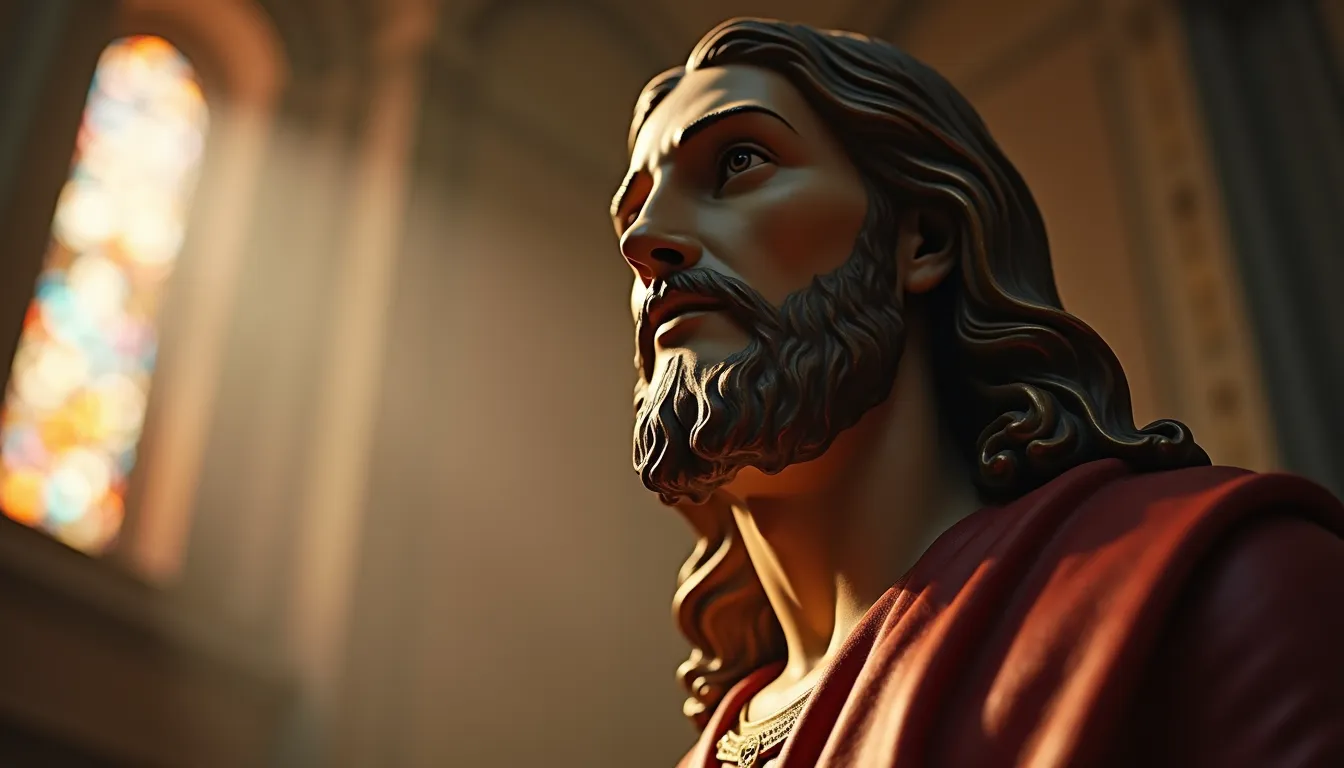
Walk into a Byzantine Catholic church and you are surrounded by images — Christ on the walls and ceiling, the Mother of God above the altar, saints gazing out from every side. You may see the faithful bow before them, light candles, even kiss them. For many Christians this raises an immediate and sincere worry: isn’t this the very thing the Bible forbids? Isn’t this idolatry?
It is a fair question, and it deserves an answer. Here it is. Honoring a sacred image is not idolatry — and Scripture shows us, repeatedly and unmistakably, why. But there is a second half to the answer that usually goes unspoken: refusing to honor sacred images does not make a person safe from idolatry. More often, it simply leaves the throne empty for something else to climb onto.
What the Commandment Actually Forbids
The worry rests on real biblical ground. The prohibition against idols is stated plainly:
“You shall not make for yourself a graven image, or any likeness of anything that is in heaven above, or that is in the earth beneath, or that is in the water under the earth; you shall not bow down to them or serve them.” (Exodus 20:4-5)
“You saw no form of any kind the day the Lord spoke to you at Horeb out of the fire. Therefore watch yourselves very carefully, so that you do not become corrupt and make for yourselves an idol, an image of any shape…” (Deuteronomy 4:15-16)
At first glance these seem to forbid every image of anything in heaven, on earth, or in the sea. But read closely, the commandment forbids a specific act: bowing down to them and serving them. It is the worship of images, not their existence, that is prohibited.
This matters, because the stricter reading collapses the moment you test it. If the text forbade all images outright, it would forbid every photograph, every illustration, every child’s drawing of a bird or a fish — anything depicting “anything that is in heaven above, or that is in the earth beneath.” Almost no one believes that. And the instant you grant that some images are permitted, you have conceded the real principle: the commandment is about worship, not craftsmanship.
The Images God Commanded
“And you shall make two cherubim of gold; of hammered work shall you make them, on the two ends of the mercy seat. Make one cherub on the one end, and one cherub on the other end; of one piece with the mercy seat shall you make the cherubim on its two ends. The cherubim shall spread out their wings above, overshadowing the mercy seat with their wings, their faces one to another; toward the mercy seat shall the faces of the cherubim be. And you shall put the mercy seat on the top of the ark; and in the ark you shall put the testimony that I shall give you. There I will meet with you, and from above the mercy seat, from between the two cherubim that are upon the ark of the testimony, I will speak with you of all that I will give you in commandment for the people of Israel.” (Exodus 25:18-22)
Here is the part of the conversation that usually gets left out. The same Law that forbids idolatry also records God commanding sacred images to be made.
In Exodus 25:18-22, God instructs Moses to fashion two golden cherubim for the top of the Ark of the Covenant — the holiest object in Israel’s worship, kept in the Holy of Holies itself. He commands cherubim woven into the curtains of the Tabernacle (Exodus 26:1). When Solomon built the Temple at God’s own direction, it was carved throughout with cherubim, palm trees, and open flowers (1 Kings 6:23-35). The most sacred spaces in all of Israel’s worship were filled with images God had asked for.
But the clearest case is the bronze serpent. When Israel was dying in the wilderness from the bites of fiery serpents — an allusion to sinful corruption — God told Moses to mount a bronze serpent on a pole; anyone who looked at it would live (Numbers 21:8-9). Christ Himself would later point to that very image as a foreshadowing of His crucifixion (John 3:14).
And then the story turns. Centuries later, the people began burning incense to that same bronze serpent — and the godly king Hezekiah destroyed it (2 Kings 18:4). Nothing about the object had changed. What changed was the human heart standing before it. The same bronze serpent was righteous when Israel looked to it in faith and idolatrous when Israel began to worship it.
There is the whole distinction, contained in a single object: the image is never the problem. How we hold it in our heart is.
What Idolatry Actually Is
So if idolatry is not the making of images, what is it?
Idolatry is a condition of the heart. It is worshiping something other than God, or loving something more than God — letting anything take the place that belongs to Him alone. It has far less to do with what sits on a shelf than with where our devotion finally rests.
A photograph of your grandmother on the nightstand is not idolatry; it is love and memory. It would become idolatry only if you loved her more than God. Skipping the Lord’s Day for football tickets is nearer the real thing — not because football is evil, but because in that moment something small has been seated above God. Idolatry is always a disordering of love. It is never the mere presence of an object.
The Double Standard We Don’t Notice
Once you see idolatry clearly — as a matter of the heart’s allegiance — a strange inconsistency in our own culture comes into focus.
Consider the Statue of Liberty: a colossal human figure that, as it happens, is modeled on the Roman goddess Libertas. Millions honor it without a flicker of hesitation. It even resides in a national park, a sort of modern-day sacred grove where the trees are prohibited from being cut down. We lay wreaths at war memorials. We salute the flag and pledge ourselves to it. We stand in silence before the Tomb of the Unknown Soldier. Every one of these is an act of reverence directed at a physical object or image — and almost no one calls it idolatry, because we instinctively understand the difference between honoring a symbol and worshiping it.
That instinct is sound. But notice what happens to it the moment religion enters the room. The same person who would never call a folded flag idolatrous may recoil at the sight of someone lighting a candle before an icon of Christ. The intuition that served us perfectly a moment ago mysteriously switches off. And as a result, without even realizing it, we end up holding secular objects in higher regard than Godly ones. We show more honor to worldly things than heavenly ones.
And this points to something easy to miss. When sacred images are pushed out, the human impulse to revere does not vanish — it attaches to something else. Flags, monuments, photographs, celebrities, national heroes fill the space and receive honors no one thinks to question. The very effort to avoid idolatry can quietly leave the throne open for lesser things to claim. A house swept clean of heavenly images is rarely empty for long.
What an Icon Is — and Isn’t
This is where the Byzantine tradition has something clarifying to offer, because it has been thinking carefully about these questions for a very long time, and it uses a precise vocabulary for them.
An icon is not an idol but a window. The tradition treats sacred images as visual theology — a way of teaching and remembering the realities of the faith, accessible to everyone regardless of age, ability, or education. An icon of the Nativity or the Crucifixion can carry an entire chapter of the Gospel in a single glance. And the honor shown to an icon never terminates on the wood and paint; it passes through the image to the one it represents.
We already understand this instinctively in another setting. When we give the Bible a prominent spot on our bookshelves, or treat it with respect — making sure our children don’t color and tear the pages — no one would think we are worshiping ink and leather. The honor passes through the book to the living Word it contains. An icon works the same way: the reverence passes through the image to Christ, or to the saint who belongs to Christ.
The tradition even keeps distinct words for distinct things. Latria — adoration, worship in the fullest sense — belongs to God alone, and to no one and nothing else. Dulia is the honor we give the saints, the kind of honor we naturally give anyone we love and admire. A heightened form, hyperdulia, is reserved for Mary alone among creatures — still infinitely short of worship, but the highest honor any creature can receive. These are not hairsplitting distinctions. They are the guardrails that keep veneration from sliding into worship.
Scripture Honors the Holy
“If one member is honored, all rejoice together.” (1 Corinthians 12:26)
If all of this still feels foreign, it is worth seeing how naturally the honoring of holy people and holy things runs through the New Testament itself.
When Elizabeth, filled with the Holy Spirit, cries out to Mary, “Blessed are you among women!” she gives extraordinary honor to another human being (Luke 1:41-42) — and the Spirit who inspires the words is plainly not committing idolatry. In Acts, the sick are carried into the streets so that Peter’s shadow might fall on them (Acts 5:15), and handkerchiefs that had merely touched Paul are taken to the sick, who are healed (Acts 19:11-12). God Himself works through physical things connected to holy people, and Scripture records it without a hint of condemnation.
There is even a passage often raised as an objection that, looked at closely, proves the very point. In Acts 14, the crowds at Lystra try to worship Paul and Barnabas as gods — and the apostles tear their garments in horror, crying, “We also are men, of like nature with you” (Acts 14:11-15). This is sometimes cited as a warning against honoring the saints at all. But it shows the opposite. The apostles refuse worship — latria, the honor due to God alone — precisely because they are creatures. They do not refuse honor at all — they are honored many times throughout the New Testament; they refuse to be honored in the way that is reserved only for God. That is exactly the line the Church has always drawn. Worship is for God. Honor may be shared.
And honor, it turns out, is not merely permitted but commended. Writing to the Corinthians about the Body of Christ, Paul says that “if one member is honored, all rejoice together” (1 Corinthians 12:26). To honor the saints — the members of Christ’s body who have finished their race — is not a grudging exception to the rule. It is something Scripture treats as good.
The Deepest Reason: God Became Visible
“You saw no form of any kind the day the Lord spoke to you at Horeb out of the fire. Therefore watch yourselves very carefully, so that you do not become corrupt and make for yourselves an idol, an image of any shape…” (Deuteronomy 4:15-16)
“The Word became flesh and dwelt among us.” (John 1:14)
Beneath all of this lies the deepest reason of all, and it is the one most worth sitting with.
For most of human history God could not be depicted, because God had never been seen. “You saw no form,” Moses reminded Israel — and to carve a form of the formless would have been to invent a lie. But then something happened that changed what was possible. “The Word became flesh and dwelt among us” (John 1:14). God took a human face. Real eyes saw Him; real hands touched Him.
After the Incarnation, to depict Christ is not a denial of the commandment but a confession of the Gospel. To paint the face of Jesus is to say, in color and line, that God truly became man — that the invisible has made Himself visible, that matter is not beneath Him but good enough for God to inhabit and, one day, to raise incorruptible. The earliest Christians grasped this in the catacombs, where they painted Christ and His saints on the walls of the very places they hid to survive. To insist that the visible can never point to the divine is, in the end, to flinch from the one thing Christianity most boldly claims: that in Jesus Christ, God became visible.
This is why icons matter so much in the Christian East. They are not decoration, and they are not superstition. They are the Incarnation, confessed in wood and paint.
In Practice
In ordinary life, none of this looks dramatic. A Byzantine Catholic home usually has an icon corner — a few images, perhaps a candle or a small hanging lamp, in a quiet place set aside for prayer. It is not so different from the corner of any home where photographs of beloved family are kept, except that here the family includes Christ, His Mother, and the saints. In church, icons surround the worshiper and draw the eye and the heart upward into prayer. None of it displaces God. All of it points toward Him.
Icons are not relics of a superstitious past. They are the natural expression of a faith that takes the Incarnation seriously — that believes God really did become visible, and that the visible can therefore lead us back to Him. The safeguard against idolatry was never the bare wall. It was the rightly ordered heart: God first, above every other love, and everything else — flags and memorials and family photographs and icons alike — held in its proper place beneath Him.
Continuing the Core Faith Series
One question remains — not of doctrine now, but of worship itself. You have walked through what the Byzantine Catholic Church believes; the final article in the Core Faith series steps into the church on a Sunday morning and shows where all of it comes together at once — in the Divine Liturgy, and where each part of it comes from in Scripture.
Next: The Divine Liturgy: A Scriptural Tour — How we worship, and where every piece of it comes from in the Bible.