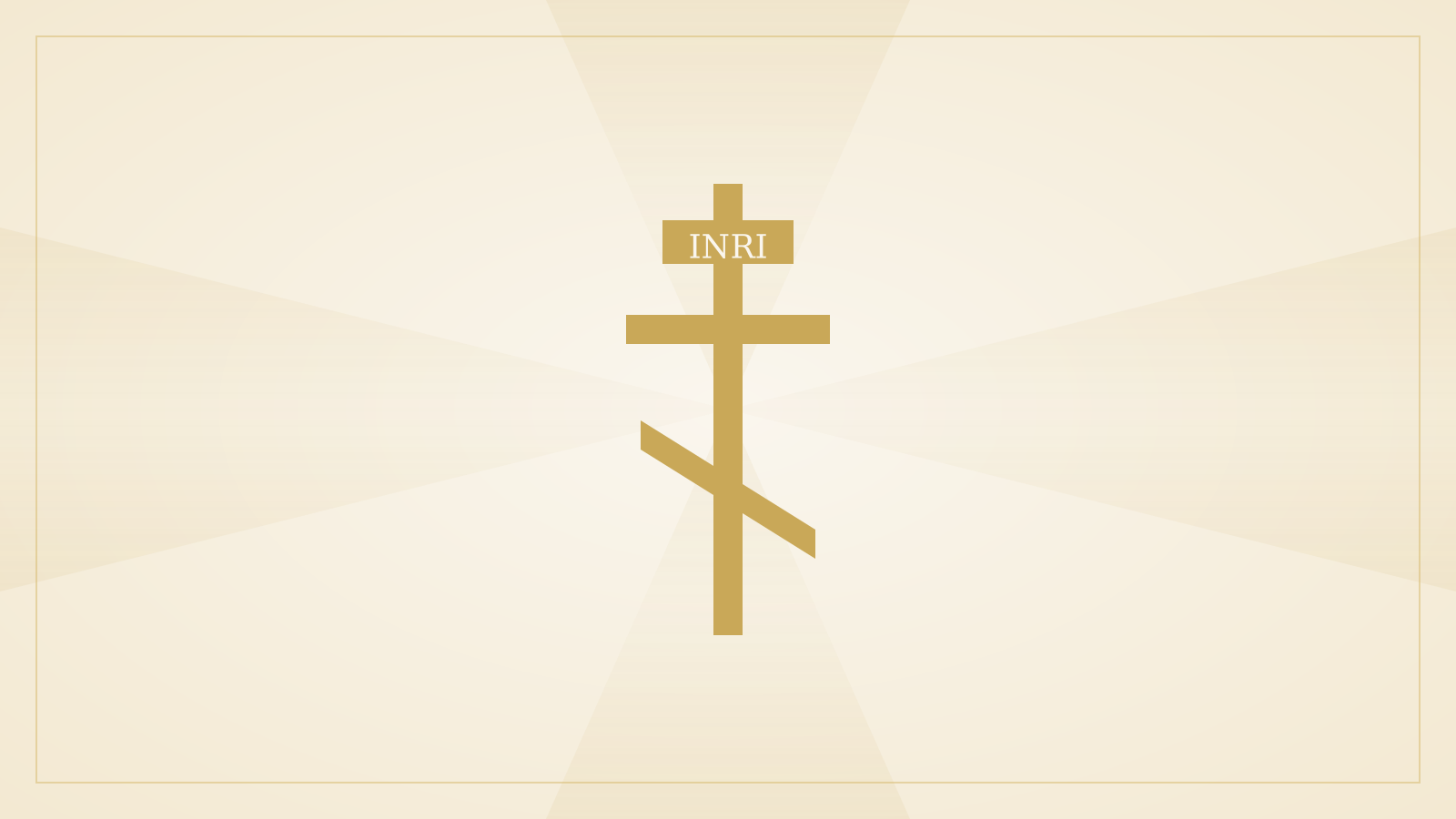
If you have spent any time in a Byzantine Catholic church, you have noticed the distinctive three-barred cross — sometimes called the Eastern Cross, the Slavonic Cross, or (less precisely) the Russian Orthodox Cross. It is not decoration. Each of the three bars is anchored directly in the Gospel accounts of the Crucifixion itself.
The top bar: the title above Christ’s head
All four Gospels record that Pilate placed an inscription on the cross above Christ’s head.
“Pilate also wrote a title and put it on the cross; it read, ‘Jesus of Nazareth, the King of the Jews.’ Many of the Jews read this title… and it was written in Hebrew, in Latin, and in Greek.” (John 19:19-20)
Western crosses sometimes show this as INRI — short for the Latin Iesus Nazarenus Rex Iudaeorum. The Byzantine cross simply renders the bar itself, sometimes with the inscription, sometimes blank.
(Matthew 27:37, Mark 15:26, and Luke 23:38 all record the same inscription in slightly different wording — which is why John tells us it was written in three languages.)
The middle bar: the crossbeam
The large horizontal bar is the crossbeam where Christ’s hands were nailed. Every Christian cross has this. The three-barred cross simply renders it in proportion to the others.
The bottom bar: the footrest, and the two thieves
The bottom bar represents the suppedaneum — the footrest where Christ’s feet were nailed. Roman crucifixions sometimes included a small projection at the base of the cross to support the weight of the body. The Byzantine tradition depicts this bar at a tilt.
The angle has a theological meaning. The bar rises on Christ’s right side (the viewer’s left) and falls on his left side (the viewer’s right). This points to the two thieves crucified beside him.
“One of the criminals who were hanged railed at him, saying, ‘Are you not the Christ? Save yourself and us!’
But the other rebuked him, saying, ’…Jesus, remember me when you come into your kingly power.’
And he said to him, ‘Truly, I say to you, today you will be with me in Paradise.’” (Luke 23:39-43)
The repentant thief — on Christ’s right — was promised Paradise. The unrepentant one — on Christ’s left — mocked him and was lost. The slant of the bottom bar tells this story visually: the side that rises points up toward Paradise; the side that falls points down toward perdition.
It is a sermon in geometry. The same cross. The same Savior. Two opposite responses.
The skull at the base
Many Byzantine crosses also show a skull at the base. This represents an ancient Christian tradition that Golgotha — Hebrew for “the Place of the Skull” (Matthew 27:33; Mark 15:22; John 19:17) — was where Adam, the first man, was buried. The tradition holds that Christ’s blood ran down through the rock onto Adam’s skull, redeeming the first man and through him all humanity.
This tradition appears in many early Christian writers from the second century onward.
One cross, the whole story
The top bar names who hangs there. The middle bar names what happens. The bottom bar names why it matters — and that the choice it represents is yours to make. The skull names how far back the redemption reaches.
What looks unfamiliar at first is, in fact, one of the most theologically rich crosses in all of Christian iconography. Every detail comes straight from the Gospel itself.
Scripture. As the apostolic Church read it.