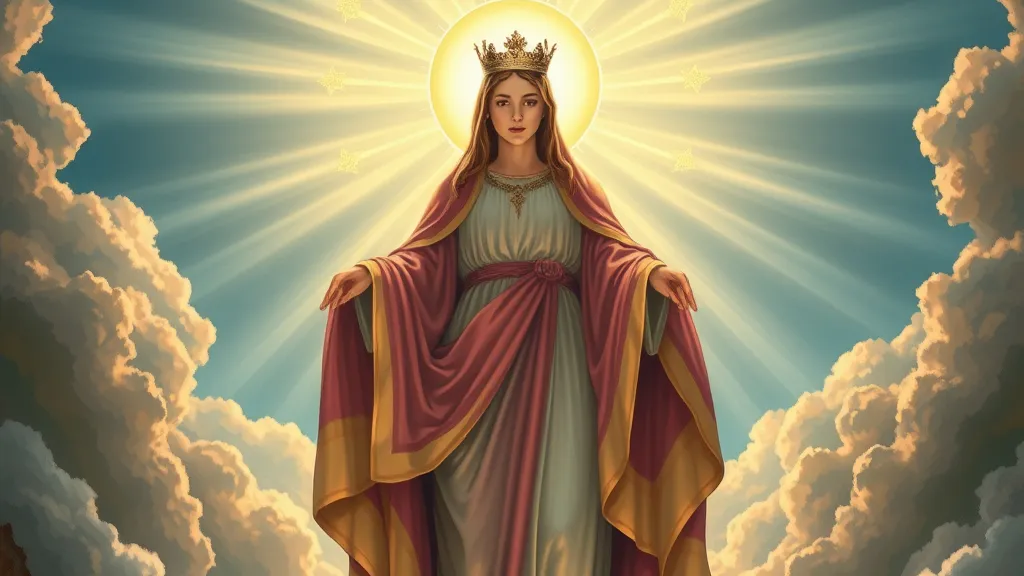
The claim that Mary is the Queen of Heaven makes some Christians uncomfortable. It sounds like an addition to the gospel — a later theological development, foreign to the simple minimalistic Christianity of the New Testament. The objection often runs: “Jesus is the King. Mary is His mother, sure, but calling her Queen of Heaven puts her in a place that belongs to Christ alone.”
This article, along with the majority of Christians, confirms that Mary really is Queen of Heaven, but the more important argument is much larger than Mary. Once you understand what the New Testament actually promises to Christians, Mary’s queenship stops being an exception that needs defending and becomes the first and fullest example of something promised to every faithful Christian. The discomfort with Mary’s role often comes from not realizing that you yourself are promised to be crowned, to reign, to judge, and to share in the divine nature of God. That humanity itself, from the beginning made in God’s image, was meant to be all pure.
The Christian promise is much greater than most Christians realize. Mary just got there first.
Before we get to her, let’s start somewhere that may surprise you: with what the Pharisees and Jews of the time believed.
The Old Covenant Promise: A Bodily Resurrection at the End of Time
“And when he was at his last breath, he said, ‘You accursed wretch, you dismiss us from this present life, but the King of the universe will raise us up to an everlasting renewal of life.’” (2 Maccabees 7:9)
Most Christians know the Pharisees as the antagonists in the Gospel narratives — the legalists who clashed with Jesus over the Sabbath, the hypocrites Jesus warned His disciples to avoid. Those criticisms were real and Jesus delivered them sharply. But on the doctrinal questions about what happens after death, the Pharisees held positions that aligned with Jesus’s own teaching. The dominant Jewish view of the period — held by the Pharisees and by most observant Jews — was that there would be a real, bodily resurrection of the dead at the end of time.
You can see this directly in the New Testament. When Paul stands trial before the Jewish council in Acts 23, he splits the room by declaring: “Brethren, I am a Pharisee, a son of Pharisees; with respect to the hope and the resurrection of the dead I am on trial” (Acts 23:6). The result is immediate: the Pharisees in the council take Paul’s side, while the Sadducees — who denied the resurrection — opposed him. Paul deliberately framed the Christian hope as a continuation of the Pharisaic hope in the resurrection in order to sow confusion and get the Pharisees to defend him.
Or look at Martha’s confession in John 11. When Jesus tells her that her brother Lazarus will rise again, she answers: “I know that he will rise again in the resurrection at the last day” (John 11:24). She doesn’t need to be taught the doctrine of the resurrection — she already holds it. It’s the standard Jewish hope. The shock isn’t that there is a resurrection, the shock comes when Jesus replies: “I am the resurrection and the life; he who believes in me, though he die, yet shall he live.”
So the Old Covenant promise was real, but limited: a bodily resurrection at the end of time led by the Messiah, when God would set all things right. This was a tremendous hope. It was what the faithful Jews of the Old Testament lived and died believing.
But the New Testament makes clear that Christ has promised something greater — not in place of the resurrection, but in addition to it.
The Greater Promise: Sharing in the Divine Nature
“His divine power has granted to us all things that pertain to life and godliness, through the knowledge of him who called us to his own glory and excellence, by which he has granted to us his precious and very great promises, that through these you may escape from the corruption that is in the world because of passion, and become partakers of the divine nature.” (2 Peter 1:3-4)
Read that line again. Partakers of the divine nature. This is not “your soul goes to heaven when you die.” This is not “you get a bodily resurrection at the end of time” — though both of those are true. This is something more radical: Christians are promised to actually share in what God is. The Byzantine tradition has a word for this — theosis, meaning something like union with God — but it isn’t a Greek innovation; it’s right here in Peter, in the canonical text every Christian acknowledges.
Paul makes the same astonishing claim in different words. He tells the Corinthians:
“Do you not know that the saints will judge the world?… Do you not know that we are to judge angels?” (1 Corinthians 6:2-3)
To the Romans he writes that Christians are “heirs of God and fellow heirs with Christ” (Romans 8:17). To Timothy he says that “if we endure, we shall also reign with him” (2 Timothy 2:12).
Christ Himself promises this repeatedly in His own words. To the church of Laodicea He says:
“He who conquers, I will grant him to sit with me on my throne, as I myself conquered and sat down with my Father on his throne” (Revelation 3:21)
He says this in multiple other places too. To the church of Thyatira: “He who conquers and who keeps my works until the end, I will give him power over the nations, and he shall rule them with a rod of iron” (Revelation 2:26-27). And in the many parables of the kingdom, Christ repeatedly describes faithful servants being elevated to authority: “you have been faithful over a little, I will set you over much; enter into the joy of your master” (Matthew 25:21). Most strikingly, in His great prayer before the Passion, Christ tells the Father: “The glory which you have given me I have given to them, that they may be one even as we are one” (John 17:22). The very glory the Father gave to Christ, Christ gives to His disciples.
These aren’t isolated verses. This is the consistent New Testament teaching. The Christian who is faithful to Christ is promised to reign with Him, to judge with Him, to receive a crown (James 1:12, 2 Timothy 4:8, 1 Peter 5:4, Revelation 2:10, Revelation 4:4), and to share in the divine nature itself.
Once you see this, the question is no longer “is it OK to call Mary Queen of Heaven?” The question is: why has this incredible promise been almost entirely absent from popular Christian preaching?
The Difference in Direction
There’s a strikingly vivid contrast between the Old Covenant and the New Covenant that drives the point home.
In Numbers 16, when Korah and his followers rebel against Moses, God’s judgment is dramatic: “the earth opened its mouth and swallowed them up, with their households and all the men that belonged to Korah and all their goods. So they and all that belonged to them went down alive into Sheol; and the earth closed over them” (Numbers 16:31-33). The judgment is to go down — bodily, alive, into the earth. The direction is downward, into Sheol.
Now compare what happens to Stephen, the first Christian martyr, as he dies in Acts 7. As the stones begin to fall, Stephen sees something:
“Behold, I see the heavens opened, and the Son of man standing at the right hand of God.” (Acts 7:56)
The direction is reversed. Where the Old Covenant promise was to go down alive into the earth to await a bodily resurrection, the New Covenant blessing is to see up into heaven, where Christ Himself is standing to welcome the faithful martyr home, to share in His portion of the Kingdom.
This is the trajectory of the entire biblical story. The Old Testament saints went down to Sheol to wait. The New Covenant faithful go up to be with Christ. Same God. Same promise of bodily resurrection at the end of time. But added to that promise is something Stephen saw and the Old Testament saints did not: Christ Himself, ready to receive His own right now. Ready to give them crowns so they can reign forever with Him.
You Are Promised a Crown
So return to the original promise. The faithful Christian is not promised mere survival into the afterlife. The faithful Christian is promised:
- To be “made partakers of the divine nature” (2 Peter 1:4)
- To sit on Christ’s throne with Him (Revelation 3:21)
- To judge the world and even angels (1 Corinthians 6:2-3)
- To reign as kings and priests (Revelation 1:6, 5:10, 20:6)
- To receive a crown of life (James 1:12, Revelation 2:10)
- To receive a crown of righteousness (2 Timothy 4:8)
- To receive a crown of glory (1 Peter 5:4)
- To inherit all things (Revelation 21:7)
- To rule over many (Matthew 25:21, Luke 19:17)
- To do greater works than Christ Himself (John 14:12)
This is the inheritance. This is what the Christian is promised. The cumulative force of these passages, taken seriously, should reorient how we think about the Christian life. We are not promised mere salvation in the minimal sense of “not going to hell.” The Pharisees had that promise in the Old Covenant. As Christians we are promised to reign with Christ. To be crowned. To judge. To share in the divine nature itself.
Mary’s Crown
It is in this context — and only in this context — that the doctrine of Mary as Queen of Heaven makes sense.
A Crown of Twelve Stars
One of the main Biblical arguments for calling Mary Queen of Heaven comes from Revelation 12, where John sees “a great portent appeared in heaven, a woman clothed with the sun, with the moon under her feet, and on her head a crown of twelve stars” (Revelation 12:1). Clothed in the sun, with the moon under her feet — clear signs of power and authority. The chapter then describes this woman bringing forth “a male child, one who is to rule all the nations with a rod of iron” — that is, Christ. The image has multiple layers (as Revelation’s images often do), and many Christians have rightly seen the woman as representing the Church or Israel. But the figure who bears the Messiah, the one who rules with an iron scepter (Revelation 2:27; Revelation 12:5), is most naturally read as Mary herself. Metaphorically it’s the church. But literally it’s Mary. She wears a crown. She is in heaven. She gives birth to the one who rules with an iron scepter, Jesus — to think that this isn’t Mary is to deny that Jesus is the one to rule with iron and scepter. She is, in this image, a queen.
Christ Is King of Kings
The other thing often lost on a modern reader is the weight ancient titles carried. King of Kings (1 Timothy 6:13-15, Revelation 17:14) was the title borne by the Persian Shāhanshāhs and other great emperors of the ancient world — a ruler so great that lesser kings were his vassals. If Christ is the King of Kings, and Mary is His mother, then on the ancient pattern that would’ve been understood by ancient readers, Mary being called Queen was implicitly a lesser title and not in competition.
A modern reader hears the word “queen” and pictures a reigning sovereign — Queen Elizabeth, Queen Victoria — and instinctively asks whether the title rivals Christ’s own. But the original audience of the Bible wouldn’t have been troubled by calling Mary Queen of Heaven, because in their world there were many kings and many queens. There was only one King of Kings.
Now here is the key point:
What Mary is given is not different in kind from what is promised to every faithful Christian. Mary wears a crown — but the elders in Revelation 4:4 also wear crowns. Mary is in the heavenly court — but every faithful Christian is promised to sit with Christ on His throne (Revelation 3:21). Mary intercedes — but every saint in heaven is shown participating in the prayers of the church (Revelation 5:8, 8:3). Mary is honored — but all those in the Body of Christ should also be honored (1 Corinthians 12:26) and Christ promises that “if any one serves me, the Father will honor him” (John 12:26).
Every Sunday during the Byzantine Catholic Divine Liturgy this becomes clear when we explicitly honor “Mary and all the saints.” Not just Mary, although she is listed first. But Mary and all the saints. By honoring them we simply give them the same honor God already gives them.
Mary is the first. She is the fullest. She is the unique mother of the Lord. But what she is given is not an exception to the Christian promise — it is the Christian promise, lived out first in the person closest to Christ in the entire history of redemption.
The Invitation
The greater Christian promise is not just for Mary. It is for every Christian who places their faith in Christ and lives in union with Him.
You are promised to share in the divine nature. You are promised to reign with Christ. You are promised a crown. You are promised to judge angels. You are promised to be an ambassador of Christ’s power. You are promised to do greater works than Christ Himself.
These promises are in the New Testament. They are not modern-day add-ons. They are not embellishments. They are what Christ and His apostles taught the church from the beginning.
Mary’s queenship is, in the end, less a doctrine to be defended than an invitation to be received. The Christian who is uncomfortable with Mary’s crown often hasn’t realized that he himself is promised one. Once he sees that, the discomfort gives way to something else — a recognition that he has been promised something so much greater than he had imagined.
Mary is Queen of Heaven. That’s OK. It’s better than OK. Because what’s promised to her is, in proper measure, promised to you.
So receive it. Live for it. And one day — by the grace of God, through the work of Christ, in the power of the Holy Spirit — wear the crown that is being held for you.
Continuing the Core Faith Series
With Mary’s crown in view, a natural question follows: if we honor Mary and the saints — and even ask them to pray for us — how does that square with Saint Paul’s insistence that there is only one mediator between God and men? The next article in the Core Faith series steps back to ask what that one mediation actually is — the defeat of death itself — and shows, along the way, why it takes nothing from Christ to let the saints pray.